
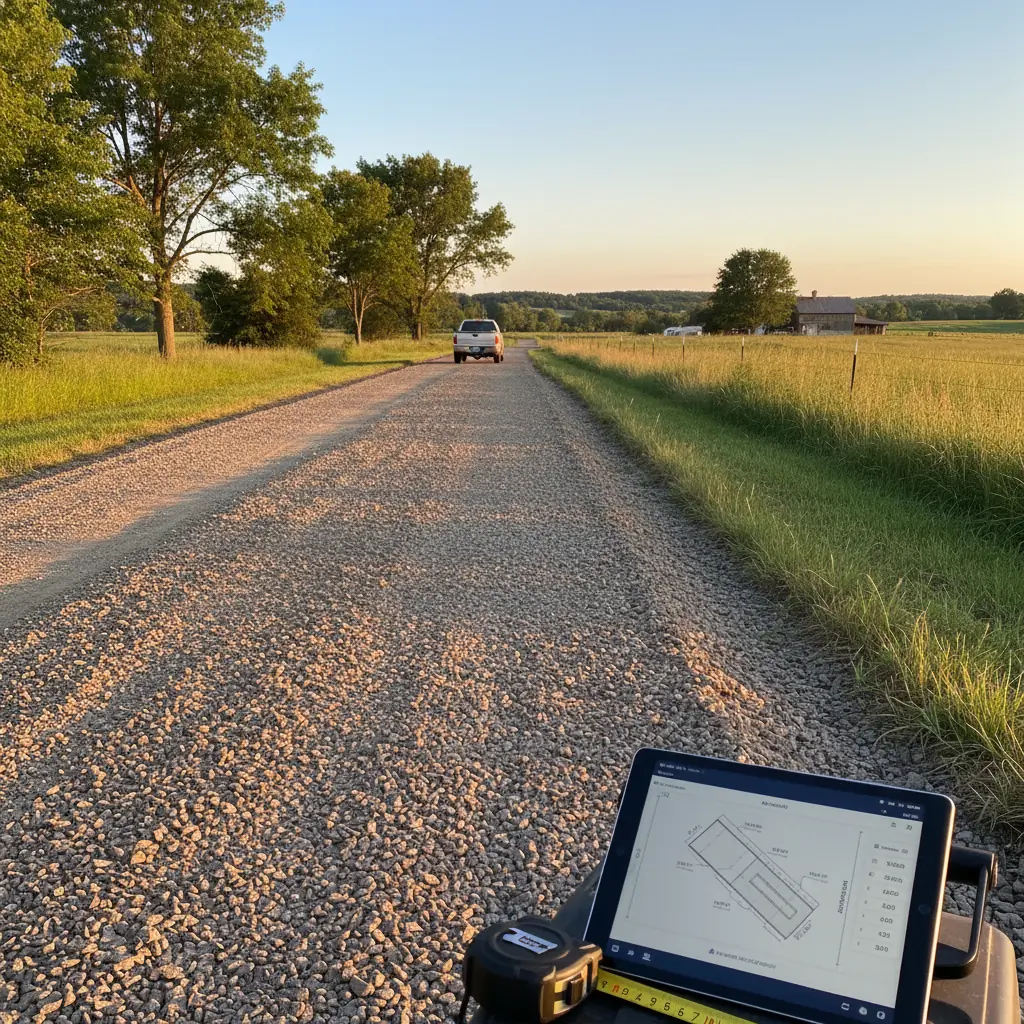
Supposing that you’re providing an up-to-date private road and looking for a cost‑effective, environmentally friendly option. Asphalt millings (also known as recycled asphalt pavement, or RAP) might be the ideal material. They provide the look of tarmacadam at a fraction of the cost, and with comely induction, they can last for days. By contrast, before you order, you must know incisively the manner in which many tons to buy. Order extravagantly little and your project grinds to a halt; order overly much and you’ve wasted money. This lead walks you through every step of calculating the right amount, with clear formulas, real‑world examples, and practical tips.
What Are Asphalt Millings?
- Driveways
- Farm roads
- Parking areas
- Paths and walkways.
- Base material for future paving.
As millings are recycled, their density and binding properties can vary slightly; a well‑compacted millings driveway can help passenger vehicles and true buoyant trucks.
Why You Need a Calculator
Estimating material by eye, bordering on always, leads to errors. A cubic yard of compacted millings weighs about 1.5 tons; then again, the loudness you need depends on your driveway’s distance, width, and desired compacted depth. An elegant online estimator does the math for you; the underlying formulas are perceptive, helping you double‑check the numbers and adjust for your particular site conditions.
Step‑by‑Step Calculation
1. Measure Your Driveway
For a rectangular driveway, quantify the . length and width in feet. Whether the soma is irregular (L‑shaped, curved, etc.), break it into rectangles, size up each area separately, and add them together. For a scratchy forecast, you can pace off the dimensions instead of using a tape measure.
2. Decide on Compacted Depth
The depth of milling after compaction is important — industry guidelines recommend.
- Light traffic (cars only): 2–3 inches.
- Standard driveway: 3 inches
- Heavy traffic (trucks, RVs): 4 inches.
Consistently assess in inches, but remember that the depth you specify is the . Final compacted depth. The loose depth will be slightly greater; that said, your order will be supported on the compacted book.
3. Calculate Volume in Cubic Feet
The loudness formula for a rectangular area is.
Volume (ft³) = Length (ft) × Width (ft) × (Depth (in) ÷ 12)
Dividing by 12 converts inches to feet. For sample, a 60 ft × 12 ft drive at 3 inches deep:60 × 12 × (3 ÷ 12) = 60 × 12 × 0.25 = 180 cubic feet.
4. Convert Cubic Feet to Cubic Yards
Tarmac millings are sold by the ton, and density is typically given in tons per cubic yard. We have 27 cubic feet in a cubic yard; for that reason.
Volume (yd³) = Volume (ft³) ÷ 27
Continuing the example: 180 ft³ ÷ 27 = 6.67 cubic yards.
5. Understand Density
Compacted asphalt millings have an average density of . 1.5 tons per cubic yard. This can vary, depending on the moisture content and the origin of the millings; instead, 1.5 is a reliable industry standard. Some suppliers may use 1.4 or 1.6 – it’s always best to ask. Supposing that they give you a different number, plainly substitute it in the formula.
Tons (exact) = Volume (yd³) × Density (tons/yd³)
Our model: 6.67 yd³ × 1.5 = 10.0 tons.
6. Add a Waste Factor
No project goes perfectly. You need extra material for.
- Compaction settling (the material compresses more than you think).
- Spillage during delivery and spreading.
- Filling low spots in the subgrade.
- Cutting and forming around edges.
A waste ingredient of . 5–10% is stock. For a first‑time project, lean toward 10%. As long as you’re experienced and your site is well‑prepared, 5% may suffice.
- Tons with waste = Exact tons × (1 + waste% ÷ 100)
- Exploitation 8% waste: 10.0 × 1.08 = 10.8 tons.
7. Round Up
Most suppliers can deliver fractional tons; it’s wise to round up to the nearest . 0.1 ton (or half a ton) to make sure you don’t run short. Assuming that your calculated tons with waste is 10.8, you might order 10.8 or round up to 11.0 for simplicity.
Final order quantity = ceil(tons with waste to one decimal) – our estimator does this mechanically.
Complete Example Walkthrough
Let’s put it all together with a realistic private road.
Length = 80 ft
Width = 10 ft
Depth = 3 inches
Density = 1.5 tons/yd³.
Waste = 7%
Step 1 – Volume in cubic feet
80 × 10 × (3 ÷ 12) = 80 × 10 × 0.25 = 200 ft³
Step 2 – Volume in cubic yards
200 ÷ 27 = 7.41 yd³
Step 3 – Exact tons
7.41 × 1.5 = 11.115 tons
Step 4 – Add waste
11.115 × 1.07 = 11.893 tons
Step 5 – Round up to the nearest 0.1 ton:
11.9 tons (or 12 tons, if you prefer whole numbers).
Factors That Can Affect Your Estimate
- Subgrade preparation: If the existing ground is uneven or cushiony, additional milling may be required to achieve a level surface. Weigh adding an extra 5% in such cases.
- Moisture content : Moist millings are heavier; accordingly, you get slightly less volume per ton. Ordering by weight is stock, or if the material is extraordinarily wet, you could wind up with less coverage than typical for the moisture level.
- Compaction method: A vibratory roller achieves a higher density than a plate compactor. The more you improve compaction, the fewer tons you’ll need for a given volume. Our formulas expect good compaction. Your drive will see heavy trucks. Consider increasing the depth to 4 inches, which will proportionally increase the required tons.
Ordering Tips from the Pros
- Call your local supplier – ask for their clear density and whether they recommend a waste component for your area. If the ground is dry, dripping soil can rut under the delivery hand truck, making spreading complex.
- Consider a spreader truck – some suppliers offer trucks with conveyor belts that evenly spread millings, saving you labor.
- Order a little extra – leftovers you can use for patching potholes or as a base for future projects.
- Check local regulations – in some areas, using recycled mineral pitch may require permits or be restricted near water sources.
Frequently Asked Questions
Q: Can I use this calculator for gravel or crushed stone?
A: Yes, even so, you’ll need the true density for that material. Gravel is typically 1.4 tons/yd³, crushed stone 1.5–1.7. Adjust the density field accordingly.
Q: How deep should I go for a car driveway?
A: 3 inches compacted is adequate for passenger vehicles. For occasional oppressive vehicles, use 4 inches.
Q: Do I need to compact in layers?
A: For depths over 4 inches, it’s best to place and compact in 2–3 in lifts to secure decorous binding.
Q: Should I seal asphalt millings?
A: Sealing is optional, but this can extend the life and give a uniform black appearance. Wait at least 6 months to allow full curing.
Q: How long do millings last?
A: With outstanding compaction and comely drainage, a millings driveway can last 10–20 years. Regular sustentation (filling ruts, occasional recompaction) helps.
Q: Can I apply millings over an existing driveway?
A: Yes, as long as the existing setup is firm and you address any drainage issues. A geotextile fabric between layers can improve public presentation.