
Attic Ventilation Calculator
Brisk Answer for Quick Reference.
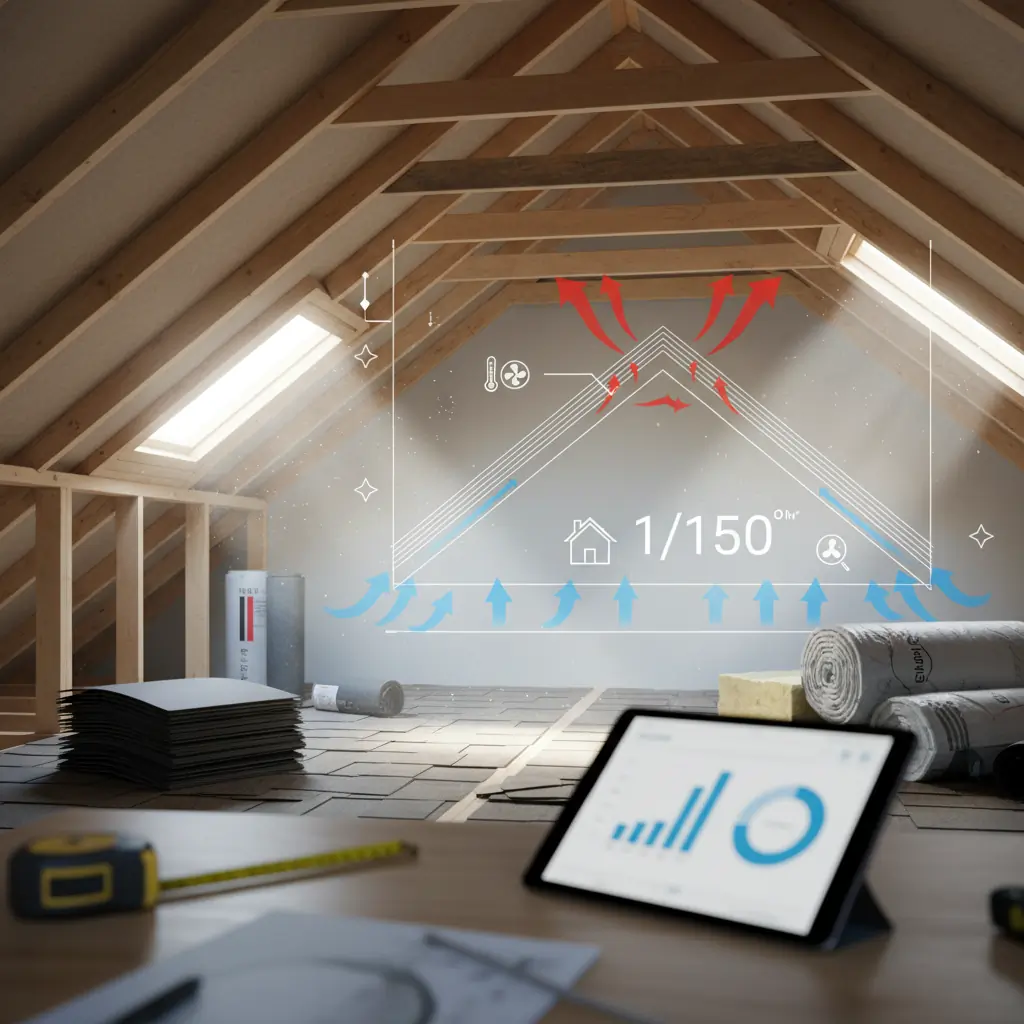
What is the 1/150 convention for noodle airing? As noted by the regular augmentative codes, the 1/150 prevail dictates that you must give 1 conventional foot of Net Free Ventilating Area (NFVA) for every 150 conventional feet of garret base space. This total ventilation system must then be balanced, with 50% at the bottom of the roof (intake vents) and 50% near the top (exhaust vents).
No matter if you’re an ambitious DIYer providing a roof replacement or a homeowner wanting to double-check a contractor’s quote, understanding the math behind your roof is critical. In this thorough Entity-focused SEO guide, we’ll analyze the building science, walk you step-by-step through with the attic ventilation calculator, and support you in defending your dwelling from top to bottom.
What is the 1/150 Rule for Attic Ventilation?
The 1/150 prevail is the baseline requirement set by the International Residential Code (IRC), particularly in Section R806, for ventilating enclosed attics and rafter spaces.
The formula is modest: Total Classical Greek Square Footage ÷ 150 = Mandatory Straight Feet of NFVA.
Even so, to truly empathize with this rule, you must understand the most weighty entity in the roof ventilation system: NFVA (Net Free Ventilating Area).
Demystifying NFVA (Net Free Ventilating Area)
A common and disastrous mistake homeowners make is assuming the physical size of a vent equals its airflow capacity. Given that you buy a vent that measures 12 inches by 12 inches (1 square foot), you don’t get 1 square foot of ventilation system.
The cause of? For vents are covered with weather louvers, insect screens, and structural baffles. These vital barriers block a big portion of the air from passing through. The NFVA is the actual, unobstructed open space where air can freely flow.
For example, a regular gable louver with a metal insect screen might provide only 50% to 60% of its physical size as NFVA. Whenever victimizing the 1/150 reckoner, you must base your math entirely on the manufacturer’s NFVA rating, not the taping evaluate dimensions of the plastic or metal casing.
[Note: Imagine an attic ventilation system as a pair of lungs. The soffit vents draw in cool, dry air from outside, while the ridge vents exhaust the hot, moist air from inside. For this “breathing” to work, the system must be properly sized and balanced.
To accurately size your noodle airing setup, you must execute a few base calculations. You will need a tape measure, a calculator, and the shock contrive of your noggin. Let’s run a sample exploitation of a standard 1,500-square-foot attic.
Step 1: Calculate Your Attic Square Footage
- Formula: Length × Width = Total Square Footage.
- Example: 50 feet (length) × 30 feet (width) = 1,500 square feet.
Step 2: Apply the 1/150 Formula
- Formula: Total Square Footage ÷ 150 = Total NFVA (in square feet).
- Demonstration: 1,500 ÷ 150 = 10 square feet of NFVA.
Step 3: Convert Square Feet to Square Inches
- Formula: Total NFVA (sq ft) × 144 = Total NFVA (sq in).
- Example: 10 × 144 = 1,440 square inches of vent area.
Step 4: Balance the System (The 50/50 Rule)
- Formula: Total NFVA (sq in) ÷ 2 = Required Intake AND Required Exhaust.
- Example: 1,440 ÷ 2 = 720 square inches for intake, and 720 square inches for exhaust.
Calculation Summary Table
|
Classical greek Level Space.
|
Length × Width | 1,500 sq. ft. |
|
Total NFVA (Sq — ft.).
|
Attic Space ÷ 150 | 10 sq. ft. |
|
Total NFVA (Sq — in.).
|
Total NFVA (Sq — ft.) × 144. | 1,440 sq. in. |
|
Required Intake Vents.
|
Total NFVA (Sq — in.) ÷ 2. | 720 sq. in. (placed at soffits). |
|
Required Exhaust Vents.
|
Total NFVA (Sq — in.) ÷ 2. | 720 sq. in. (placed at the ridge). |
The 1/150 Rule vs. The 1/300 Rule: Which Should You Use?
As the 1/150 principle is the safest baseline, building codes (IRC) allow for a reduction in compulsory ventilation — called the 1/300 rule — if strict criteria are met. Neither the 1/300 rule nor the 1/300 rule, you need no more than 1 square foot of NFVA for every 300 square feet of attic space (effectively cutting your ventilation requirements in half).
Even so, you can legally and safely use the 1/300 principle, provided that you meet one of the following two conditions.
- A Balanced System: The ventilation system is perfectly balanced. Between 40% and 50% of the required ventilation must be provided by ventilators located in the upper portion of the classical Greek (exhaust), with the rest provided at the eaves (intake). Provided that you have 100% gable vents and no soffit vents, you can’t use the 1/300 dominate.
- Vapor Retarder Installation: In colder climates (Climate Zones 6, 7, and 8), a Class I or II vapor retarder is installed on the warm-in-winter side of the ceiling (usually just behind the drywall). This prevents interior moisture from migrating into the attic, reducing the burden on the ventilation system.
Most modern roofing professionals still aim for the 1/150 rule, even though the code allows 1/300 — why? As you rarely have an outrageously large intake ventilation system, the 1/150 rule provides a wider margin of error to protect your domicile from moisture damage and extreme summer heat.
Why Precise Attic Ventilation Matters (The Science Behind It)
1. Moisture Control and Mold Prevention
In the winter, your family generates an immense measure of moisture inside the menage. Cooking, showering, running the dishwasher, and even breathing release water vapor into the air. Because warm air rises, this moisture pushes upward through ceiling penetrations (like recessed lights and attic hatches) into the frosty attic.
Given that the bean is poorly ventilated, this water vapor hits the freezing, biting roof decking and instantly condenses into liquid water or frost. The minute that the frost melts, it drips onto your insulation (ruining its R-value) and breeds toxic black mold on the rafters. A decent ventilation system removes this moisture from the house before it can condense.
2. Ice Dam Prevention
Ice dams are a homeowner’s worst nightmare in chilly climates. They form when heat from the house escapes into a poorly ventilated garret, warming the upper part of the roof. The snow on the roof melts, runs down the shingles, and hits the eaves (the overhangs). Inasmuch as the eaves aren’t heated by the classical Greeks, they’re freezing cold. The water refreezes, creating a dam of solid ice.
As more snow melts, the water pools behind this ice dam and backs up underneath your shingles, pouring directly into your living room. The 1/150 rule ensures plenty of freezing outside air is pulled into the attic to keep the entire roof deck cold, preventing the snow from melting in the maiden place.
3. Energy Efficiency and Roof Longevity
- It radiIt heats your living space, making your air conditioner work harder and raising your energy bills. terally bakes your asphalt shingles from the inside out, causing them to blister, curl, and fail years before their warranty expires. (Actually, most shingle manufacturers will void your warranty provided that they discover you did not follow the 1/150 ventilation requirement.
Choosing the Right Vents for Your Calculation
Once you know the strategy for the many square inches of NFVA you need, you must buy the right hardware. Vents are categorized into two types: Intake and Exhaust.
Intake Vents (The Lower System)
Intake vents sit at the lowest point of the roof, generally below the eaves.
- Continuous Soffit Vents: These are long strips that run the entire length of the eave. They are the most efficient intake alternative, often providing around 9 square feet of NFVA per linear foot.
- Individual/Undereave Vents: Rectangular vents cut into the soffit at regular intervals. You will be motivated to estimate how many you need, based on their individual NFVA ratings.
- Fascia Vents or Drip Edge Vents: Used for homes with zero overhangs or exposed rafter tails, for which standard soffits aren’t possible.
Exhaust Vents (The Upper System)
- Ridge Vents: The undisputed champion of exhaust. These run continuously along the peak of your roof. Because they sit at the highest point, they exhaust the hottest air easily. A basic ridge vent provides about 18 square inches of NFVA per linear foot.
- Gable Vents: Louvered vents placed on the sides of the noggin.
- Box Vents (Roof Louvers): Static, evenly spaced vents placed across the upper roof. Each box vent normally provides about 50 square feet of NFVA.
- Turbine Vents (Whirlybirds): Wind-powered vents that actively pull air out of the classical Greek.
Essential Warning: Do not mix exhaust vent types!
Assuming you have calculated your needs and decided to install a ridge vent, you must block off your antique gable vents or box vents. Mixing two types of exhaust vents creates a “short circuit.” Air will enter through the gable vent and exit through the ridge vent, completely ignoring the soffit vents at the bottom. This leaves the lower half of your roof trapped with stagnant, moist air.
FAQs
Can you have too much attic ventilation system?
You can definitely have too much exhaust ventilation. As long as you have significantly more exhaust NFVA than intake NFVA, the exhaust vents will start searching for air to pull from anywhere they can. This causes “negative tension which can literally suck the conditioned (heated or cooled) air out of your living space through your ceiling, costing you a fortune in energy bills. But you can rarely have too much intake ventilation system. A slight excess of intake over exhaust is really perfect.
How do I find the NFVA rating of an existing vent?
Most modern vents have their NFVA rating stamped directly onto the plastic or metal casing. If not, you can mainly look up the brand and model online. As a rule of thumb, a standard 8″ x 16″ rectangular soffit vent provides roughly 56 square feet of NFVA.
Does a vaulted ceiling use the same formula? Yet the application is different. Vaulted or cathedral ceilings don’t have a significant open noggin volume; instead, your rafter bay is a mini-attic. You must apply the 1/150 rule to ensure that there’s a continuous gap (using insulation baffles) from the soffit all the way to the ridge for every single rafter cavity.
Do I incorporate my garage in the square footage calculation?
Only supposing that the garage is attached and shares the exact same, unbroken attic space as the rest of the firm. If the garage is partitioned from the main house by a firewall or framing, you must calculate and ventilate it as a separate system.
Conclusion
Mastering the 1/150 rule for bean ventilation systems is one of the most cost-effective ways to maintain your home’s structural integrity, improve indoor air quality, and lower your energy bills. By picking the time to work out your needful Net Free Ventilating Area (NFVA), converting it to square inches, and balancing it perfectly between intake and exhaust, you lock in your roof can “breathe” the way it was engineered to.
No matter whether you’re battling ice dams in winter or skyrocketing AC costs in summer, looking up at your roof vents is usually the best place to start.