
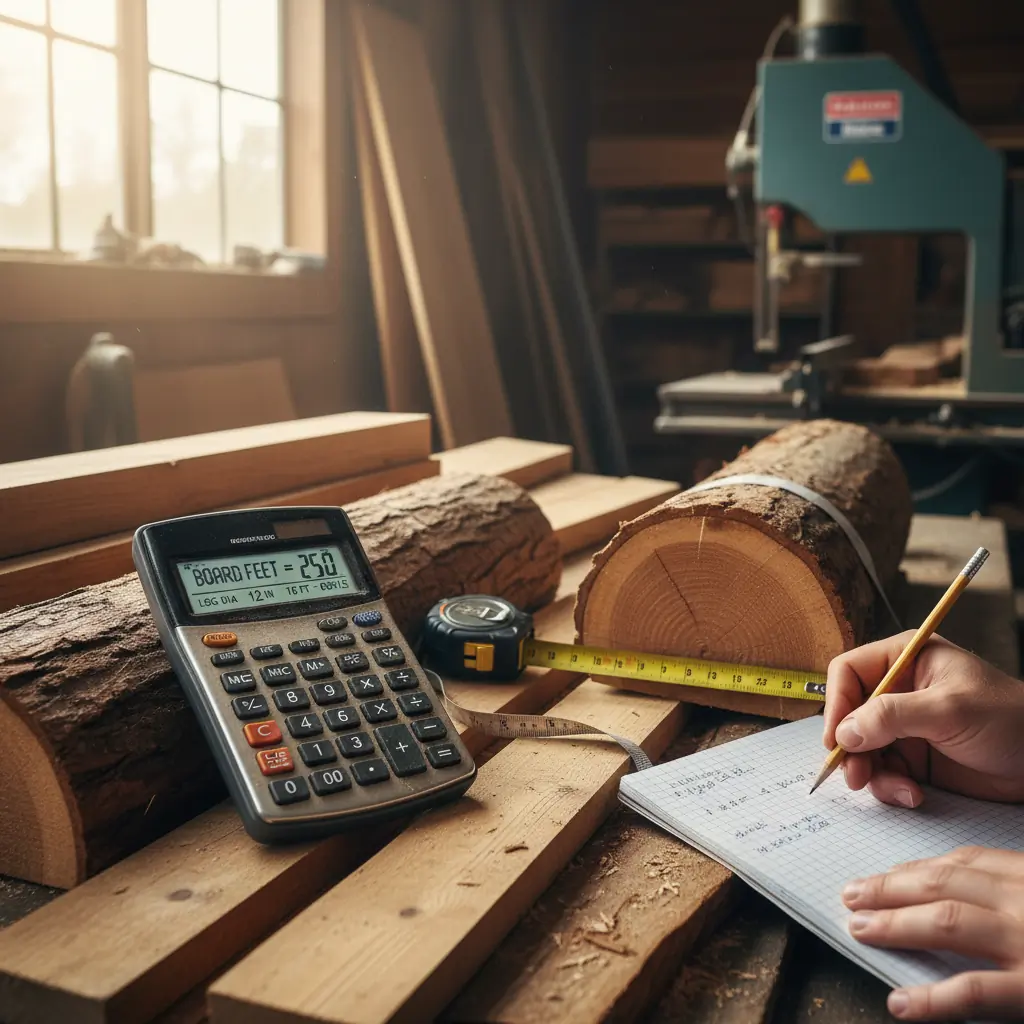
Understanding board feet is important for anyone working with lumber, whether you’re a professional carpenter or a DIY enthusiast. Knowing how to calculate board feet helps you estimate costs, plan your project, and make sure you buy the right amount of wood. The Board Feet Log Rule Calculator is a helpful resource that speeds up and improves the accuracy of calculations. This article explains what board feet mean, how they’re measured, and shares practical tips for easy estimation.
What is Board Feet
A board base is a unit of measurement for the bulk of a ram. Mainly, it represents a wooden composition measuring 1 foot long, 1 foot wide, and 1 inch thick. This basic augmentative impede helps measure a baseball game bat’s actualized dimensions, making it easier to cost and sell. The theme is key in the lumber industry. Supply an orderly way to measure the quantum of forest being traded. To gauge room feet, you multiply the duration (in feet) by the breadth (in feet) by the height (in inches).
This measurement is essential when estimating how much material you need and what it will cost. For example, if you’re building a deck, you calculate the total board feet needed to budget for materials. Using board feet provides a standard way to plan, quote, and track wood for projects, keeping things clear for woodworkers, carpenters, and builders.
What is Board Feet of Lumber
Board feet of lumber refers to the volume of wood measured in board feet, as described earlier. It is a standardized unit that allows straightforward comparison and pricing across different units of measure, such as pounds.
Lumberyards and suppliers typically price their products based on the cost per table pick. This mechanism allows buyers to promptly determine the cost of the pound they want, whether they’re purchasing thin boards or thick timbers. Knowing the planks of timber is essential for truth.
Material estimation.
For example, consider a board that is 2 inches thick, 6 inches wide, and 8 feet long. To calculate its board feet, multiply 2 (thickness in inches) x 6 (width in inches) x 8 (length in feet), then divide by 12. This results in (2 x 6 x 8) / 12 = 8 board feet. Clarifying these step-by-step calculations helps with budgeting and ensures you purchase the correct amount of materials. Understanding board feet also improves inventory management, reduces waste, and optimizes resource use in woodworking projects. This concept is a key industry practice and ensures fair trade.
What is Board Feet Measurement
Plank feet measure involves hardening the intensity of bat victimization, the standard system of a control panel foot. The rudimentary formula is: Board Feet = (Thickness in inches) x breadth in inches) x continuance in feet) / 12. This formula simplifies the tactic of determining the quantity of bat in interrogation. It’s invigorating to ensure all measurements are in the on-point units before applying the formula. By dividing by 12, for example, if the width is given in inches, convert it to feet.
Assorted tools and methods are open to reduce the computational burden. Plank Feet Log: The calculating machine automates this routine, reducing the risk of error and the need for a delivery meter. When dealing with substantial quantities of logs or complex dimensions, these calculators are, above all, practical. Apprehension and exact application of the board-foot measure check that projects are appropriately budgeted and that the take of lumber is purchased, minimizing waste and maximizing efficiency. Measuring is a must-have for dimensional lumber pricing.
What does Board Feet Mean
What board feet mean is a standardized way to quantify timber bulk, enabling easier pricing and stock list management. The timber industry uses a unit of measurement for loudness: a piece of wood measuring 1 square foot by 1 square foot by 1 inch. The significance of board feet lies in its ability to furnish a consistent metric that transcends the varying dimensions of bat products. This standardization allows for straightforward comparison and pricing, regardless of the clear dimensions of the woodwind instrument.
Consider two boards:
the first is 1 inch thick, 6 inches wide, and 12 feet long; the second is 2 inches thick, 6 inches wide, and 6 feet long. Board feet for each: Board 1 = (1 x 6 x 12) / 12 = 6 board feet. Board 2 = (2 x 6 x 6) / 12 = 6 board feet. Both boards have 6 board feet, making it straightforward to compare their costs.
This clarity streamlines transactions, improves communication, and ensures fair trade in the woodworking community—crucial for anyone involved. Board feet are used for various purposes, primarily to quantify, price, and manage lumber.
One of the most common applications is estimating the total amount of lumber needed for a construction or woodworking project. By calculating the total board feet required, you can accurately estimate material costs and set a proper budget. This is especially vital for large-scale projects, where small estimation errors can lead to significant cost overruns.
Lumber calculators
Also, board feet are used by lumberyards and suppliers to reflect product pricing. Pricing lumber by board foot provides a standardized way to sell wood, regardless of its specific dimensions. This allows customers to easily compare prices and make informed purchasing decisions.
Board feet are also used in inventory management to track the amount of lumber available, ensure efficient stock control, and minimize waste. The term is also commonly used in forestry management to estimate lumber yield from harvested trees. While board feet are primarily used to measure lumber, the term also applies to rigid foam insulation, particularly when discussing the volume needed for a project.
In this context, board feet refer to the area covered by a 1-inch-thick sheet of insulation. When considering the amount of insulation needed for walls, roofs, or floors, this measurement is highly relevant. Understanding board feet in insulation helps estimate the quantity needed, ensuring proper thermal performance and energy efficiency. Required , ensuring appropriate hot public presentation and energy efficiency.
For example, suppose you need to insulate a wall that is 10 feet long and 8 feet high, using 1-inch-thick rigid foam. First, calculate the total wall area: 10 x 8 = 80 square feet. Because each square foot at 1-inch thickness equals 1 board foot, you need 80 board feet of insulation. Using this step-by-step process ensures you purchase the right amount, minimizes waste, and optimizes insulation performance. Also, remember that insulating ability (R-value) is important when selecting materials. This clear example aids material comparison.
What is Board Feet for Spray Foam
When using spray foam insulation, board feet are used to find out how much foam you need. This measurement helps contractors and homeowners determine how much spray foam to use to achieve good insulation. Unlike rigid insulation boards, spray foam expands to fill gaps, so board-foot calculations differ. Spray foam is often sold by the cubic foot, but the amount covered is shown in board feet to help with estimates.
For example, if spray foam has a yield of 12 board feet per cubic foot, 1 cubic foot of foam will cover 12 square feet at a thickness of 1 inch. To estimate spray foam needed fTo estimate the spray foam needed for a job, calculate the area to cover and multiply by the thickness in inches to determine the total board feet.are feet at 2 inches thick requires 100 x 2 = 200 board feet of foam. Understanding this relationship enables accurate estimation. Application type and R-value further determine spray foam requirements.
What is Board Feet Compared to Square Feet
Board feet compared to square feet reflect different aspects of mensuration. Square feet calculate area, whereas board feet evaluate a book. StraightBoard feet compared to square feet reflect different aspects of mensuration. Square feet calculate area, whereas board feet evaluate a book. Straight feet are secondhand for quantifying the area of a two-dimensional space, such as the floor area of a room or the surface area of a wall. In contrast, panel feet quantify the bat’s mass, accounting for its thickness, width, and length. Understanding the distinction between these two units is vital for precise material estimation and cast provision.
For example, if you’re carpeting a room, you use square feet to determine how much carpet you need. However, if you’re building a deck, you use board feet to calculate the amount of lumber required. While square footage measures coverage area, board footage tells you the material needed at a specific volume.
This difference is essential in construction and woodworking, helping ensure accurate measurements and proper project budgeting. Both concepts are used in construction estimating. They are properly budgeted. The concepts are secondhand in construction estimating and economic planning. This estimate allows foresters and landowners to evaluate the probable significance of a tree originally, before it’s harvested.
By accurately estimating panel pick concessions, they can make informed decisions about which trees to harvest, the strategy for sustainably managing the forest, and future economic returns. This practice is vital for maximizing the forest’s merit by ensuring its long-term health and productivity. The routine, for the most part, involves exploitation. log scaling techniques.
Various factors influence the growth of a standing tree’s fundamental yield, including species, diameter at breast height (DBH), height, and general health. log rules Like . Doyle Log Rule , the Scribner Log Rule, and. The International 1/4-inch Log Rule is one-fourth of a board foot, calculated from these factors. Simultaneously, as these rules provide a useful estimate, they aren’t unfailingly perfectly precise, and actual results can vary. Close estimation requires knowledge and a thorough understanding of forestry principles — the use of. Remote sensing and LiDAR technology are improving the accuracy of these estimates.
Frequently Asked Questions
What is the difference between the Doyle Log Rule and the Scribner Log Rule?
The Doyle Log Rule. Scribner Log Rule: There are two methods for forecasting the board groundwork mass of a log. The Doyle Log Rule is illustrious for significantly underestimating the volume of smaller logs, whereas the Scribner Log Rule is generally considered more accurate, chiefly for smaller logs. From a practical standpoint, the Doyle convention deducts a concentrated amount for slab and kerf, leading to its underestimation. The Scribner principle uses a diagrammatic strategy to estimate volume, resulting in a more realistic product. One thing to note is that the option between the two depends on the definite application and the size of the logs being measured.
How does tree diameter at breast height (DBH) affect board foot yield?
The tree diagram diameter at the front peak (DBH) is a vital ingredient in determining the board base width of a tree. More often than not, the bigger the DBH, the greater the panel foundation gives. This is for a big diam substance; there’s more at your disposal, a woodwind instrument in the tree. The relationship between DBH and board foundation issue isn’t linear; as the DBH increases, the get-on-ground yield increases at an increasing rate. Foresters use DBH measurements in conjunction with log rules to estimate a tree’s mass, a crucial step in sustainable forest management.
Can a Board Feet Log Rule Calculator be used for different types of wood?
Yes. The Table Feet Log Dominate Reckoner can be used for different types of woodwind, but it’s essential to use the appropriate log rule for the distinct type of wood and the region in which the tree diagram is located. Antithetical log rules may be more applicable to specific species or tree diagram sizes. Some calculators authorize you to stimulate distinct parameters, like the species of forest and the log principle to be used, to polish the truth of the computation. Discerning the wood’s characteristics and selecting the appropriate log are critical for accurate estimation.
What are the limitations of using a Board Feet Log Rule Calculator?
Simultaneously as . The Board Feet Log Rule Calculator is a helpful tool, but it has limitations. The calculating machine relies on the accuracy of the stimulus data, like the length and diameter of the log. If these measurements are inaccurate, the calculated board foundation volume will also be inaccurate. Also, log rules are based on averages and may not accurately reflect the actual intensity of a specific log due to variations in shape, defects, and internal rot. External factors and imperfections can affect the final figure. Always consider the calculated merit as a figure.
How does moisture content affect board foot measurements?
Wet content doesn’t immediately impact the get on base measure itself, as table feet is a standardized unit of measurement of strength. That said, wet subject matter can affect the angle and stability of the bat. As it dries, the forest shrinks, altering its dimensions and potentially affecting its usability. High moisture content can likewise lead to decay and fungal ontogenesis, reducing the quality and worth of the timber. That’s the cause of it; it’s key to weigh wet message when storing and victimizing timber; otherwise, it doesn’t affect the poster foundation calculation.
Conclusion
Sympathy and accurately conniving. Board feet are fundamental for anyone involved in woodworking, building, or forestry. Board-Foot Log Rule Calculator Simplifies this approach, providing useful estimates for substantial costs, project planning, and timber direction. By mastering this principle, you can secure efficient resource use, sound budgeting, and sustainable practices in the logging industry.