
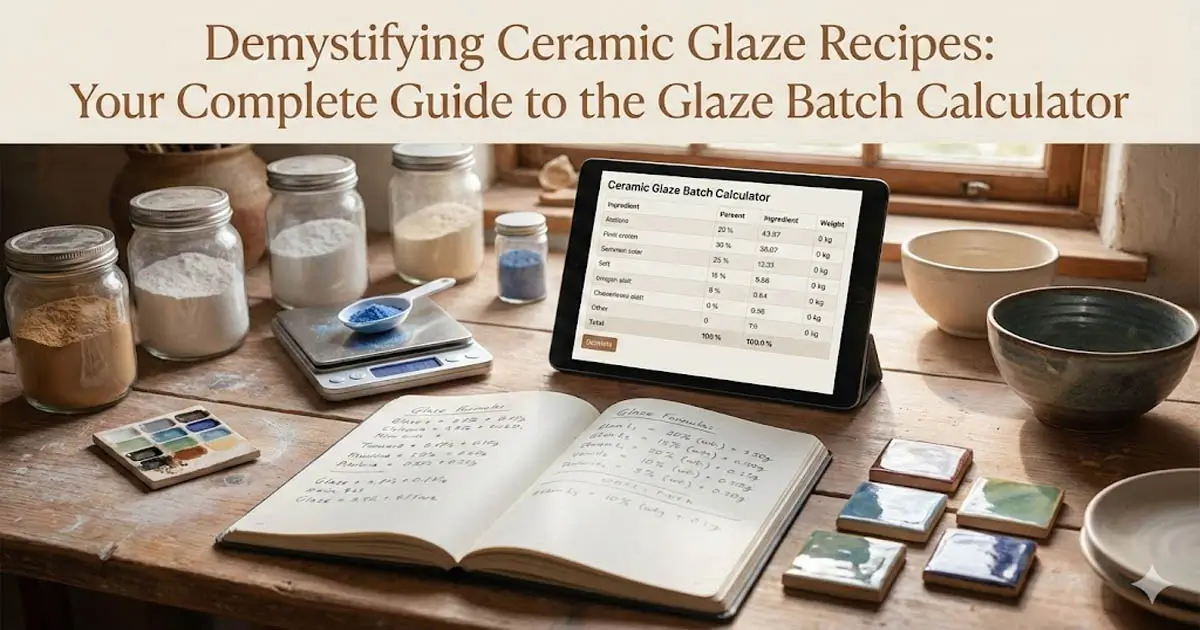
Pottery combines earth, water, and fire, but glaze formulation demands exact chemistry. Whether you are mixing a large 10,000-gram batch or testing a 100-gram sample, accurate calculations are essential. Even a small mathematical error may cause substantial glaze defects.
While I do not work with clay, I excel at processing complex calculations. Using the interactive Ceramic Glaze Batch Calculator, this guide will show you how to scale glaze recipes accurately. With the formulas, step-by-step instructions, and examples below, you can approach your studio math with confidence.
- Ceramic Glaze Batch Calculator --
1. The Challenge of Ceramic Glaze Formulation
Most professional pottery resources present glaze recipes in percentages. The base ingredients—glass formers, fluxes, and stabilizers—total 100%. Colorants and additives, such as Cobalt Oxide or Bentonite, are added as additional percentages beyond this base.
Why do potters use percentages rather than listing ingredients in grams?
- Universal Sharing: A recipe written in percentages can be scaled to fit a tiny teacup or a massive floor vase.
- Chemical Analysis: Percentages allow ceramic chemists to examine the molecular unity formula (UMF) to predict how the glaze will melt and behave at specific cone temperatures.
- Easy Tweaking: If you know a glaze has 30% Silica, you can easily drop it to 25% to test a matte variation.
However, a digital scale measures grams, not percentages. You must convert recipe percentages into gram weights based on your desired batch size. This is where the two calculation modes are useful.
2. Mode 1: Calculating Weight from Percentages (Percent → Weight)
This is the most common mathematical task in a pottery studio. You have a recipe written in percentages, and you want to mix a specific total amount of dry material—say, 5,000 grams. This is the most common calculation in a pottery studio. You have a recipe expressed as percentages and want to mix a specific total amount of dry material, such as 5,000 grams, for a standard 2.5-gallon bucket. Choose the total amount of dry glaze you need. (Let’s say 2,000 grams).
- Find the percentage of each ingredient in your recipe. (For example, 12% Gerstley Borate).
- Convert the percentage to a decimal: Divide the ingredient’s percentage by 100. 12 ÷ 100 = 0.12.
- Multiply by the batch size: Multiply that decimal by your total target weight. 0.12 × 2000 = 240.
- Weigh your ingredient: You need exactly 240 grams of Gerstley Borate for this batch.
Read More: Model Train Incline Clculator
Practical Example 1: Mixing a Tenmoku Test Batch
You found a deep brown Tenmoku glaze recipe online, but you want to mix only a 300-gram test batch to evaluate it on your clay body before making a larger quantity.
The recipe calls for 8% Red Iron Oxide, which gives Tenmoku its rust-brown color. How many grams of Red Iron Oxide are needed for a 300-gram batch?
- Identify batch size: 300 grams.
- Identify ingredient percentage: 8%.
- Convert to decimal: 8 ÷ 100 = 0.08.
- Calculate weight: 0.08 × 300 = 24.
- Result: You must precisely weigh out exactly 24 grams of Red Iron Oxide.
3. Mode 2: Calculating Percentages from Weights (Weight → Percent)
This mode is for reverse engineering. If you have a recipe recorded in grams or are combining leftover ingredients, converting these weights to percentages lets you document and recreate successful results. Understanding the glaze’s chemistry also requires expressing ingredients as percentages.
The Formula: Ingredient Percentage = (Ingredient Weight ÷ Total Batch Weight) × 100
Here is the numbered process for reverse engineering your glaze weights:
- Calculate the total weight: Add up the weights of all the individual ingredients in your bucket to find the total.
- Identify the individual ingredient weight: Pick the specific material you want to calculate.
- Divide by the total: Divide the individual weight by the total batch weight to get a decimal.
- Convert to a percentage: Multiply that decimal by 100.
- Document the recipe: Record this percentage in your glaze log.
Practical Example 2: Reverse Engineering a Custom Celadon
Suppose you experimented in the studio and mixed a custom batch of clear glaze without a standard recipe. You used 1,200 grams of Silica, 800 grams of Custer Feldspar, and 500 grams of Whiting.
What is the percentage of Silica in this new recipe?
- Calculate total weight: 1200 (Silica) + 800 (Feldspar) + 500 (Whiting) = 2,500 grams total.
- Identify target ingredient weight: Silica is 1,200 grams.
- Divide by total: 1200 ÷ 2500 = 0.48.
- Convert to percentage: 0.48 × 100 = 48.
- Result: Your new experimental recipe consists of 48% Silica.
4. A Comprehensive Studio Scenario: Scaling a Classic Stoneware Glaze
To master the calculator, consider a complete recipe example. The interactive tool includes a standard Cone 6 Stoneware Glaze. Assume you want to mix a 1,500-gram batch of this base.
Here is the exact numbered breakdown of how the math applies to every single ingredient in the bucket:
1. Silica (The Glass Former) – 25.0%
- Math: 25 ÷ 100 = 0.25
- Batch Calculation: 0.25 × 1500 = 375
- You will weigh out 375 grams of Silica.
2. Potash Feldspar (The Primary Flux) – 30.0%
- Math: 30 ÷ 100 = 0.30
- Batch Calculation: 0.30 × 1500 = 450
- You will weigh out 450 grams of Potash Feldspar.
3. Whiting (The Secondary Flux / Calcium Source) – 15.0%
- Math: 15 ÷ 100 = 0.15
- Batch Calculation: 0.15 × 1500 = 225
- You will weigh out 225 grams of Whiting.
4. Kaolin (The Alumina Source / Suspension Agent) – 20.0%
- Math: 20 ÷ 100 = 0.20
- Batch Calculation: 0.20 × 1500 = 300
- You will weigh out 300 grams of Kaolin.
5. Dolomite (The Magnesium Flux / Matting Agent) – 10.0%
- Math: 10 ÷ 100 = 0.10
- Batch Calculation: 0.10 × 1500 = 150
- You will weigh out 150 grams of Dolomite.
The Final Checking Step: Always check your math by adding up the final gram weights. 375 + 450 + 225 + 300 + 150 = 1,500 grams. Because the total matches your desired batch size exactly, you can proceed to the mixing table with absolute confidence.
5. Golden Rules for Safe and Accurate Glaze Mixing
Accurate calculations are only the first half of the process. Bringing those numbers into accurate calculations is only the first step. Applying them in the studio calls for careful practice. As you use your expressions, follow these crucial guidelines:rticulates that cause silicosis when inhaled. Never mix dry glazes without wearing a properly fitted N95 or P100 particulate respirator. No calculation is worth risking your respiratory health.
- Invest in a Quality Scale: Kitchen scales lack the precision needed for glaze chemistry, especially for colorants like Cobalt or Copper. Use a digital scale that measures to at least 0.1 grams.
- Tare Your Container: Always place your mixing bucket or weighing boat on the scale and press the “Tare” (or “Zero”) button before adding your dry ingredients. Otherwise, you will accidentally include the mass of the plastic container in your ingredient calculations. Sieve Thoroughly: After weighing your dry ingredients and adding water, pass the glaze through an 80-mesh or 100-mesh sieve. This breaks up clumps and secures a uniform mixture.
- Keep Complete Records: Maintain a studio notebook. For each batch, record the date, target percentages, calculated weights, and the amount of water added for your preferred viscosity.
Understanding the math behind your materials lets you move beyond premixed commercial glazes and take full creative control of your ceramic surfaces. With the right formulas, the calculations become manageable.