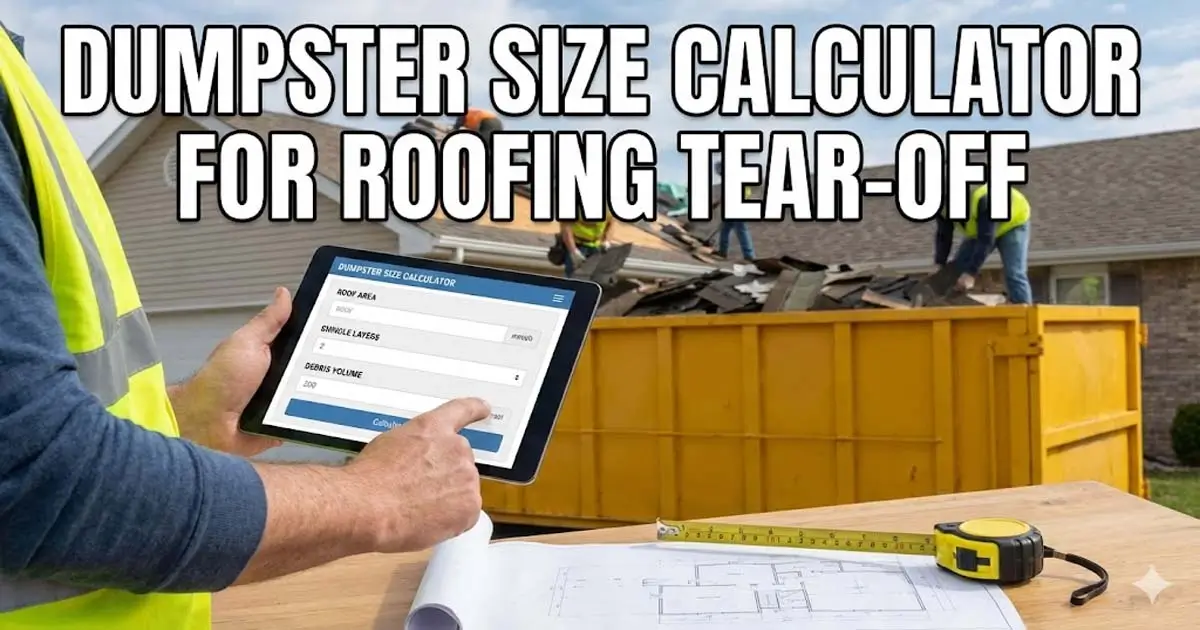
Planning a roofing project? One of the biggest logistical challenges is determining which dumpster size to rent. Order too small, and you’ll have overflowing debris (and extra fees). Order too large and you waste money. This guide explains in detail how to estimate the volume of roofing tear‑off debris and the factors that affect it. Also, how to choose the right dumpster size – with a handy calculator to do the math for you.
ℹ️ Material factors: Asphalt 0.6, Concrete tile 0.8, Clay tile 0.7, Slate/Wood 0.5 (cu yd per square per layer)
📦 Estimated Debris Volume
—
🚛 Recommended Dumpster Size
—
⚖️ Weight Note
—
✨ Volume estimate – always confirm weight limits with your rental company ✨
Why Accurate Dumpster Sizing Matters
Roofing tear-off generates a surprising amount of waste. For example, a typical asphalt shingle roof on a 2,000 sq ft home can produce 6–10 cubic yards of debris. If you underestimate, you may need a second dumpster and face overage charges. If you overestimate, you pay for unused space. Additionally, dumpster rental companies often have size restrictions based on where you can place the container. Accurate sizing saves money and keeps the job running smoothly.
Now that you understand the importance of accurate sizing, let’s look at how Dumpster Sizes are defined.
Dumpsters are measured in cubic yards (a cube 3 ft × 3 ft × 3 ft). Common sizes for residential roofing projects:
10 yard
12′ × 8′ × 3.5′
Small sheds, porches, 1‑layer tear‑off on a small roof
15 yard
14′ × 8′ × 4′
1‑layer tear‑off on an average house (1,500–2,000 sq ft)
20 yard
20′ × 8′ × 4′
2‑layer tear‑off, larger homes,. When including some renovation debris
30 yard
22′ × 8′ × 6′
Multi‑layer tear‑off on large homes, commercial jobs
40 yard
22′ × 8′ × 8′
Major tear‑offs, entire roof replacements with multiple layers
With that in mind, most roofing jobs fall into the 15–30-yard range, so keep these standard sizes in mind as you estimate your needs.
Factors That Determine Debris Volume
Roof Area. If you know your home’s footprint and the roof pitch, you can compute the actual roof area. For a simple gable roof, multiply the footprint by a pitch factor (e.g., 1.06 for a 4/12 pitch, up to 1.3 for a steep 12/12 pitch). Because it’s the roofer’s standard unit, our calculator asks for roof area in squares. If you only know square footage, divide by 100 to get the roof area in square feet. If you only know square footage, divide by 100.
Look, the number of Layers
How many existing layers of roofing will be torn off? Building codes typically allow up to two layers of shingles over a new underlayment, but many tear‑offs involve only one or two layers. More layers mean more debris.
Material Type
Different roofing materials have different densities and bulk when torn off.
Asphalt shingles: The most common. Loose tear‑off shingles plus underlayment, nails, and felt. Approx. 0.6 cubic yards per square per layer.
Concrete tile: Heavy and bulky. Approx. 0.8 cubic yards per square per layer.
Clay tile: Slightly less dense than concrete, about 0.7 cubic yards per square per layer.
Slate: Dense stone. The tiles are thin with a moderate volume—about 0.5 cubic yards per square per layer.
Wood shakes: Lightweight but bulky, approx. 0.5 cubic yards per square per layer.
These figures are based on industry experience and should be considered estimates. Actual volume may differ depending on how tightly the debris is packed, whether nails are removed, and the amount of underlayment present.
Here’s the thing, Waste Factor
In addition to the shingles/tiles themselves, you’ll have underlayment, flashings, and nails. Also, perhaps some decking if rot is found. Adding a 10% waste factor is a safe bet. If the roof has many valleys, debris in a dumpster is hardly ever compacted perfectly. If you break up materials and stack tiles neatly, you might fit more, but for estimation purposes, assume loose fill. Eatly, and you might fit more. But for estimation, assume loose fill.
Formula
Total Cubic Yards = (Roof Area in squares) × (Number of Layers) × (Material Factor) × (1 + Waste % / 100)
Compare your volume estimate to dumpster sizes. Choose the smallest size that fits, leaving some headroom.
Example 1: Asphalt Shingles, 1 Layer
Roof area: 20 squares (2,000 sq ft)
Layers: 1
Material factor: 0.6
Waste: 10%
Volume = 20 × 1 × 0.6 × 1.10 = 13.2 cubic yards
This would fit comfortably in a 15-yard dumpster (a 13A 20-yard roll would also work, but costs more).
Example 2: Two Layers of Concrete Tile
Roof area: 25 squares (2,500 sq ft)
Layers: 2
Material factor: 0.8
Waste: 10%
Volume = 25 × 2 × 0.8 × 1.10 = 44 cubic yards
That’s too much for a 40-yard dumpster (44 > 40). You would need a second haul. Alternatively, you might split the load into two hauls.
Alternatively, you might split into two hauls.
Weight Considerations
While dumpsters are sized by volume, they also have weight limits. A typical 20-yard dumpster might have a 2‑3 ton (4,000‑6,000 lb) weight limit. Roofing materials are heavy:
Asphalt shingles: about 200–250 lbs per sq. Slate weighs 800–1,200 lbs per square per layer. If your debris is heavy, as with tile or slate, you may exceed the dumpster’s weight limit before filling it. Always ask your rental company about weight allowances. Our calculator focuses on volume, but we’ll include a note about weight considerations. But we’ll include a note about weight considerations.
Step‑by‑Step Guide to Using the Calculator
To use the calculator, measure your roof area in square feet. If you have the roof footprint and pitch, calculate the roof area as Roof area = Footprint × Pitch Factor. For example: A 1,500 sq ft footprint with a 6/12 pitch (1.12 factor) equals 1,680 sq ft, which is 16.8 squares. Count the existing layers on your roof. If you’re unsure, check the roof edge for a clearer view. If you still need help, ask a roofer to confirm the material type. Most residential roofs use asphalt shingles.
Add a waste factor: 10% is typical for simple roofs, 15% for complex roofs.
Click Calculate. The tool will provide an estimated debris volume in cubic yards. Suggested dumpster size(s) based on common sizes.
Once you have your estimate, contact your local dumpster company with your calculated volume. Ask about weight limits, especially for tile or slate roofs.
Practical Tips
Always round up – It’s better to have a little extra space than to overflow. If your calculation is 14.5 yards, go with it. Ask about overfilling, since dumpsters must be level for safe transport. Overfilling results in extra fees or a refusal of the haul. If you’re tearing off metal or other recyclables, keep them separate—these may be taken for free or at a lower cost. keep them separate – they may be taken for free or at a lower cost.
Consider decking replacement—If replacing plywood, add its volume separately. One 4×8 sheet equals about 0.35 cubic yards. Check local regulations – Some areas require permits for street dumpsters.
Frequently Asked Questions
Q: Can I use this calculator for flat roofs?
A: Yes – just measure the roof area directly. For built‑up roofs with gravel, the volume factor may differ; consult a professional.
Q: What if my roof has multiple layers of different materials?
A: Use the material factor for the dominant material, or average them. The calculator is an estimate. If you have the blueprints or can measure from the ground, use the formula: Length × Width (for each plane) × Pitch Factor, then divide by 100. Many online roof area calculators can also help. Then divide by 100. Look, many online roof area calculators can help.
Q: What about debris from flashing, vents, and underlayment?
A: That’s included in the waste factor. Basically, the material factors already account for typical underlayment and accessories.
Q: Why does the calculator give a range of suggested dumpsters?
A: Because availability varies by region. Some companies have 15-yard dumpsters, others only 10, 20, or 30. The range helps you communicate with your rental company.
Conclusion
Estimating dumpster size for a roofing tear‑off doesn’t have to be guesswork. By understanding your roof area, the number of layers, and the material type, you can figure out a reliable debris volume and choose the right container. Remember, when in doubt, consult your local dumpster rental company—they see these jobs every day and can offer valuable advice. Now, let’s calculate! This guide is for informational purposes. Always validate with your rental provider concerning weight limits and local regulations. Your rental provider is concerned with weight limits and local regulations.