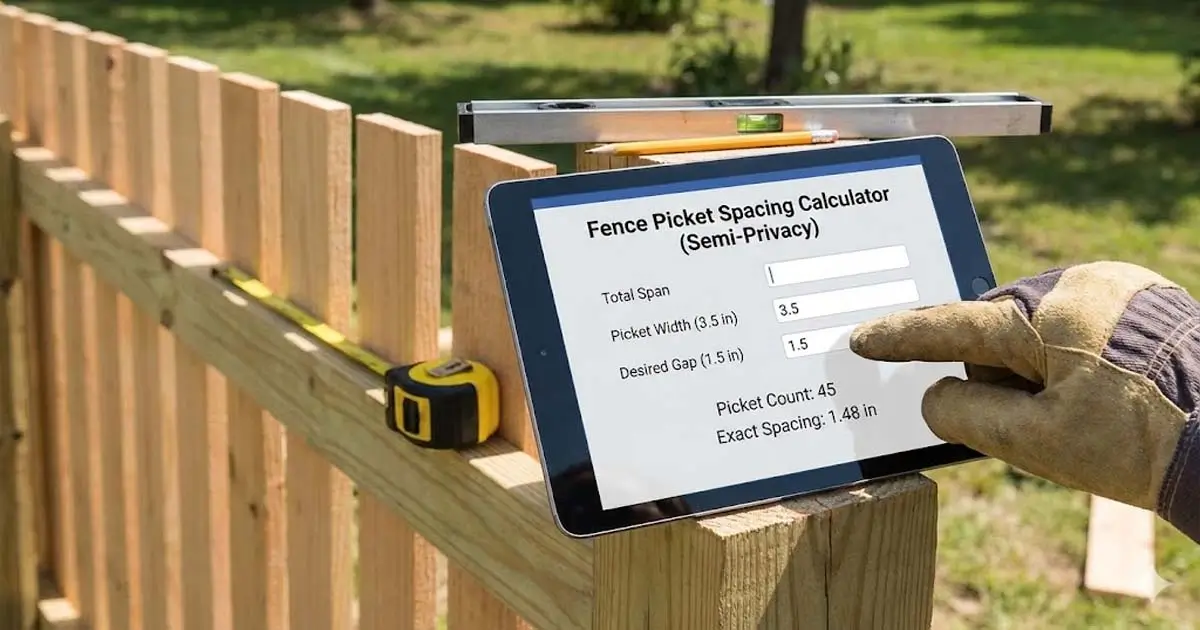
Actually, when building a fence, one of the most common design choices is the spacing between pickets. You know, a semi‑privacy fence strikes a balance between complete seclusion. Also, an open, airy feel. Here’s the thing: it allows some visibility. Also, airflow while still providing a degree of privacy. Getting the spacing right is vital for both aesthetics and function. This guide explains the math behind picket spacing and how to determine the number of pickets you need. Also, how to achieve the ideal gap for your project.
ℹ️ Enter length in feet + inches, or decimal feet. Picket width and gap in inches.
📐 Section Length (inches)
—
🪵 Pickets Needed
—
🔲 Actual Gap (inches)
—
📏 Total Picket Linear Feet
—
✨ Rounded picket count – gap adjusted to fit ✨
What Is Semi‑Privacy Fencing?
Semi‑privacy fences use gaps between pickets that are large enough to see through partially. But small enough to obscure a direct line of sight. Typical gaps range from ½ inch to 4 inches, depending on the desired level of privacy. A 1‑inch gap is a common choice – it lets light.
Also, air passes through, making it complex to see clearly through the fence. I mean, narrower gaps (under 1 inch) lean toward full privacy; wider gaps (over 2 inches) lean toward decoration. Also, open. Here’s the thing: the classic “good neighbor” fence often uses a pattern with evenly spaced pickets, sometimes with a shadowbox design (alternating sides). But for simplicity, we’ll focus on a straight‑on fence with all pickets on the same side.
Factors That Affect Picket Spacing
Picket width: Most wood pickets are 3½”, 4″, 5½”, or 6″ wide. The width directly affects how many pickets you need.
Desired gap: This is your design choice. Consider how much visibility you want.
Fence length: Measure the total linear feet of the fence section between posts. (Posts themselves take up space – we’ll account for that.)
Post placement: Fence sections usually run between posts. The length we work with is the distance from the inside of one post to the inside of the next.
The Basic Formula
For a straight fence section that starts and ends with a picket, the relationship among picket width, gap, number of pickets, and section length is: n×w + (n−1)×g = L.
Where:
nn = number of pickets
ww = width of one picket (in inches, but keep units consistent)
gg = gap between pickets (in inches)
LL = total length of the fence section (in inches). There are (n-1) spaces between n pickets (assuming you start and end with a picket). You can rearrange this formula depending on what you know:
If you know LL, ww, and gg, you can solve for nn:
$$n=L+gw+gn=w+gL+g$$
This will usually give a decimal. Look, you must choose an integer number of pickets. Typically, you round up to ensure you don’t exceed the length, then recalculate the actual gap.
If you know LL, ww. Also, want a specific number of pickets nn, you can address for gg:
$$g=L−n×wn−1g=n−1L−n×w$$
This gives the exact gap needed to fit exactly n pickets.
Step‑by‑Step Example
Suppose you have a fence section 12 feet long between posts, and you’re using 5½‑inch‑wide pickets. Also, you want a 2‑inch gap.
Convert length to inches: 12 ft × 12 = 144 incPlug into the formula:.467$$
Round up to the nearest whole number: 20 pickets.
Now, calculate the actual gap with the rounded picket count: g = (144 – (20 × 5.5)) ÷ 19 = 1.79
inches. Basically, with 20 pickets, your gap will be about 1.79 inches – slightly less than the desired 2 inches. If that gap is acceptable, you’re set. If you must have exactly 2 inches, you might need to adjust the number of pickets (try 19 pickets). Consider a different picket width.
I mean, accounting for Posts. The formula assumes the section length is measured from the inside face of one post to the inside face of the next. Posts are typically 4×4 or 6×6 and occupy space. When measuring the fence, ensure you measure the clear span between posts, not the overall center‑to‑center distance. If pickets will cover the posts (for example, if they run past the posts), include the post width in the total. For most wood fences, pickets are attached to rails that run between posts, so the section length is the clear span.n.
Practical Tips
Always round up pickets – It’s better to have a slightly smaller gap than to run out of space. Also, have to cut the pickets narrower.
Consider the ends – If your fence ends at a post, you’ll likely want a picket flush with the post face. The formula already accounts for that by starting. Also, ending with a picket.
Use consistent units – Mixing feet and inches is a common mistake. Convert everything to inches before calculating. Account for rail thickness? No, rails run horizontally behind pickets and don’t affect spacing.acing.
Think about future maintenance – A larger gap makes it easier to trim the weeds between the pickets as well.
Check local codes – Some areas have restrictions on fence height. Also, spacing, especially near property lines.
Common Spacing Scenarios
3.5″
1″
20 pickets
1.05″
3.5″
2″
16 pickets
2.13″
5.5″
1″
14 pickets
1.07″
5.5″
2″
12 pickets
2.09″
(Assumes 8‑ft section = 96 inches.)
Why Use a Calculator?
Doing this math manually for every section of fence is tedious. Also, error‑prone. A calculator that instantly computes the number of pickets. Also, the resulting gap saves time and ensures consistency across your entire fence. It also lets you play with different picket widths. Also, gaps to find the combination you like best. Our calculator below does exactly that. Simply enter your section length (in feet, inches, or decimal feet), picket width (in inches), desired gap (in inches), and it will tell you:
The exact number of pickets needed (rounded up)
The actual gap you’ll get with that number of pickets
Total pickets if you have multiple sections
Optional: total linear feet of picket material
Frequently Asked Questions
Q: What if my fence has different section lengths?
Truth be told, a: Compute each section separately and sum the pickets. Our calculator works one section at a time; you can repeat for each section.
Q: Do I need to include the pickets that go over the posts?
A: In standard construction, pickets are attached to horizontal rails that run between posts. So the posts aren’t covered. The section length is the clear span. If you plan to attach pickets directly to posts, you’ll need to adjust.
Honestly, q: Can I use this for horizontal fence spacing?
A: The same formula applies for horizontal boards, but the layout may differ (e.g., starting and ending with a gap). This calculator assumes vertical pickets with pickets at both ends.
Q: What if I want a specific number of pickets (e.g., for symmetry)?
A: Use the second formula: $g=(L−n×w)/(n−1)g=(L−n×w)/(n−1)$. Our calculator will include that option if you check the “Use fixed picket count” option.
Q: How accurate does the gap need to be?
A: For most fences, a variation of 1/8″ is unnoticeable. Our calculator gives results to two decimals, which is plenty precise.
Conclusion
Achieving the ideal semi‑privacy fence is a matter of simple arithmetic. Honestly, by understanding the relationship between picket width and gap. Also, section length, you can confidently plan your project and avoid costly mistakes. Use our calculator to experiment with different options. Here’s the thing: also, get exact material counts. Then head to the lumber yard with a clear plan! Basically, remember: when in doubt, buy a few extra pickets – they’re inexpensive. Also, handy for repairs. This guide is for informational purposes. Always follow local building codes and consult a professional for complex projects.