
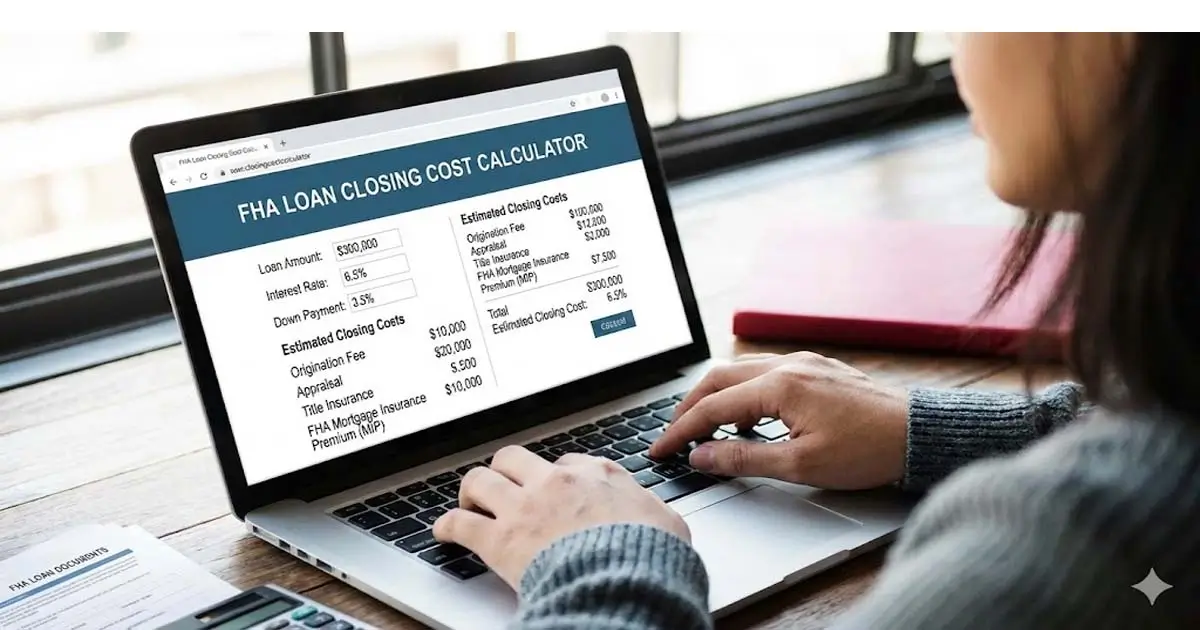
Getting an FHA loan can be a big help for first-time homebuyers in Pennsylvania. If your credit score is 580. Higher, you may only need a 3.5% down payment, which makes it easier to buy your first home.
But the down payment is just one part of the total cost. As closing costs can add thousands of dollars to upfront costs, many buyers are surprised when they see their Initial Loan Estimate.
In Pennsylvania, closing costs for an FHA loan usually range from 2% to 5% of your total loan amount. I mean, these costs include lender fees, charges from outside vendors, and government taxes. Also, prepaid escrow items. Because Pennsylvania has its own transfer tax laws.
- Here’s the thing:
- sets title insurance rates.
- National calculators are often off the mark.
Here’s a detailed breakdown of real costs in Pennsylvania, with timelines and tax charts. Also, examples.
The FHA Closing Cost Formula
To estimate how much cash you’ll need at closing, not including the 3.5% down payment, you can use this common real estate formula:
Estimated Cash to Close = (Loan Amount × Lender Fee %) + (Purchase Price × PA Transfer Tax Share) + Fixed Third-Party Fees + Escrow Prepaids.
In Pennsylvania, closing costs usually range from 3.5% to 4% of the purchase price, though this varies with local property taxes.
Breaking down each part of your closing costs can help you see where your money goes.
Understanding your closing costs reveals which are set by the government, and lets you discuss negotiating some fees with your lender.
Lender Fees (0.5% – 1.0% of Loan Amount)
Lenders charge fees to start and approve your FHA loan.
- Origination Fee: 0.5% to 1%. On a $300,000 loan, this means $1,500 to $3,000.
- Underwriting/Processing Fee: $400-$995 for document review.
- Discount Points (Optional): Pay upfront to lower your rate. The number of points purchased may be negotiated.
One point is 1% of the loan and usually lowers your rate by 0.25%. For a $300,000 loan at 6.5%, paying 1 point ($3,000) can lower your rate to 6.25%.
Third-Party Vendor Fees ($600 – $1,200 Total)
These are fixed costs paid to third-party vendors and are not kept by the lender. FHA appraisals are often stricter than conventional ones. The appraiser checks for issues such as peeling lead-based paint, missing handrails, and roof condition.
- Credit Report Fee: $30 to $55 per borrower.
- Flood Certification: $10-$20. This checks if the property is in a FEMA-designated flood zone.
- Pest Inspection (WDI): $75 to $150. A Wood Destroying Insect report is needed if the appraiser sees visible rot or if the home is in a known termite area, but it’s not required for every property.
Title and Settlement Fees (State Regulated)
In Pennsylvania, you can’t shop for cheaper title insurance; rates are set by the Title Insurance Rating Bureau of Pennsylvania (TIRBOP), so every company charges the same premium based on your loan.
- Lender’s Title Insurance: Required to protect the bank. On a $300,000 loan, the TIRBOP basic rate is exactly $1,894.25.
- Owner’s Title Insurance: Optional but strongly recommended. It protects your legal rights to the property.
- Settlement/Closing Fee: An administrative fee from the title company for handling your signing, usually $350 to $650.
- Notary & Recording Fees: Paid to the county courthouse to record your mortgage, averaging $150 to $250.
The Heavy Hitter: Pennsylvania Transfer Taxes
Pennsylvania levies a 1% state transfer tax on real estate deals, raising closing costs above those in nearby states.
Local municipalities and school districts typically add another 1% transfer tax. Buyers and sellers usually split the total evenly.
|
Most of PA (Bucks, Chester, York)
|
1.00% | 1.00% | 2.00% | 1.00% |
|
Pittsburgh (Allegheny County)
|
1.00% | 4.00% | 5.00% | 2.50% |
|
Philadelphia
|
1.00% | 2.278% | 3.278% | 1.639% |
|
Reading (Berks County)
|
1.00% | 4.00% | 5.00% | 2.50% |
|
Scranton (Lackawanna County)
|
1.00% | 2.40% | 3.40% | 1.70% |
FHA-Specific Fees: The UFMIP
All FHA loans require an Upfront Mortgage Insurance Premium (UFMIP) to fund the insurance pool.
Formula: UFMIP = Base Loan Amount × 1.75%.
For example, if you borrow $300,000, your UFMIP would be $5,250.
Most buyers add this fee to their loan balance instead of paying it in cash at closing. Next, let’s look at how this changes your loan balance and what is collected at closing.
In this example, your new loan balance would be $305,250. Along with the UFMIP, federal law allows lenders to collect extra property taxes and upfront homeowners’ insurance to fund your escrow account at closing.
Homeowners insurance: You pay the first 12 months at closing, usually $800 to $1,500, depending on the home. You’ll also pay two extra months as a buffer. Because property taxes are due at different times, your lender will collect 2 to 8 months of taxes upfront, based on your closing month. These payments contribute to your overall closing costs.
Per Diem Interest: This is the daily interest charged from your closing date until the end of the month. To see when these fees are actually paid, let’s review the typical payment timeline for a homebuyer.
Many people think you pay the full down payment and closing costs on the day of closing. In reality, these payments are spread over the 30 to 45 days it takes to complete the transaction. Let’s break down what happens when, starting from offer acceptance.
- Honestly, on day 1 (Offer Accepted), pay your Earnest Money Deposit (EMD), usually 1% to 2% of the price ($3,000 to $6,000).
- On day 10 (Inspections), buyers pay the inspector directly, usually $400–$600, as a cost separate from closing costs.
- On day 15 (Appraisal), buyers pay the FHA appraisal fee ($500–$750) upfront. At closing, they pay the remaining amount by cashier’s check or wire: down payment plus closing costs, minus the EMD and any appraisal fees already paid. Also, appraisal fees already paid.
Practical Example: A $300,000 Home in Philadelphia
For example, let’s say a first-time buyer is purchasing a $300,000 rowhome in Philadelphia. The total transfer tax is 3.278%, and the standard FHA down payment is 3.5%.
- Purchase Price: $300,000
- FHA Down Payment (3.5%): $10,500
- Base Loan Amount: $289,500
Estimated Closing Costs Breakdown:
|
Lender Fees (0.75%)
|
$2,171 | Origination and processing on $289.5k |
|
Appraisal & Credit
|
$650 | Paid upfront prior to closing |
|
Title Insurance (TIRBOP)
|
$1,843 | Regulated PA basic rate |
|
Title Settlement & Notary
|
$650 | Title company admin fees |
|
Transfer Tax (Buyer’s Share)
|
$4,917 | 1.639% (Half of Phila’s 3.278%) |
|
Escrow Prepaids
|
$3,500 | High estimate due to Phila property taxes |
|
UFMIP (1.75%)
|
$5,066
|
Rolled into loan; not paid in cash
|
|
Total Cash Needed for Costs
|
$13,731
|
(Roughly 4.5% of purchase price)
|
You’ll need $10,500 for the down payment and $13,731 for closing costs, for a total of $24,231 in cash.
If the total amount needed still feels overwhelming, Pennsylvania buyers have a few advanced strategies to help reduce upfront costs.
A. Negotiate FHA Seller Assist (Up to 6%)
FHA rules allow sellers to contribute up to 6% of the purchase price toward the buyer’s closing costs. On a $300,000 home, a seller could credit up to $18,000 at closing.
- Instead of offering $290,000, you could offer $300,000 and request $10,000 back as “Seller Concessions.” The seller receives the same amount, but you roll closing costs into your mortgage.
B. Utilize PHFA Down Payment Assistance
The Pennsylvania Housing Finance Agency (PHFA) offers state-backed programs designed to help FHA borrowers cover closing costs.
- Keystone Advantage Assistance Loan: Provides up to $6,000 or 4% of the price (whichever is less) as a second mortgage at 0% interest for 10 years.
- K-FIT (Keystone Forgivable in Ten Years): Provides up to 5% of the purchase price or appraised value, with no maximum limit. The loan is forgiven 10% each year; stay 10 years, and repayment is not required.
C. Choose Premium Pricing (Lender Credits)
You may accept a slightly higher interest rate in exchange for a cash credit from your lender. For example, if the standard rate is 6.25%, you could choose a 6.75% rate and get a $4,000 lender credit at closing to help cover transfer taxes and title fees.
Can I roll my closing costs into the FHA loan balance?
No. Except for the 1.75% UFMIP, you cannot roll origination fees, TIRBOP title fees, or PA transfer taxes into your loan. Seller assist or lender credits are required to offset these costs.
Are there FHA income limits in Pennsylvania?
No. Standard FHA loans have no income limit. If you use PHFA down payment assistance, you’ll need to meet county income and purchase price limits.
If the FHA appraisal fails, do I get a refund for the fee?
No. The appraiser performed the labor of visiting the home and writing the report. If the home meets the FHA minimum property standards, the $500–$750 fee is non-refundable.