
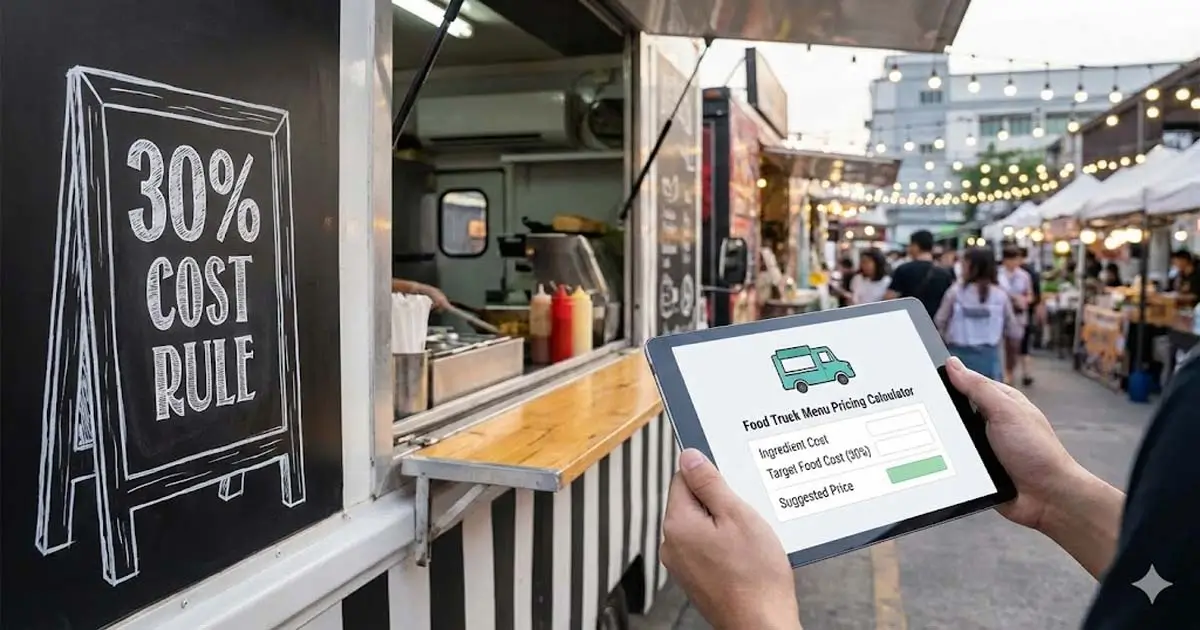
Finding the right price for your food truck menu is a balance. If you set prices too high, you lose customers. Too low, you won’t cover costs or make a profit. Many food businesses use the 30% food cost rule: ingredient costs should be about 30% of the selling price. This guide explains the rule, shows how to use it, and how a calculator can help set effective prices.
What is the 30% Food Cost Rule?
Restaurants and food trucks use the 30% food cost rule to control ingredient expenses. If a dish costs $3.00, you charge about $10.00 ($3.00 ÷ 0.30). The remaining 70% covers labor, rent, utilities, insurance, truck maintenance, marketing, and profit.
This rule isn’t absolute. Costlier items like seafood may exceed 30%, while pasta may be less. Still, aiming for 30% helps your food truck stay profitable.
Why 30%?
The 30% target is based on industry experience. It leaves enough margin to cover:
- Labor: wages, insurance, fuel, permits, and similar costs (15–25%)
- Marketing and misMarketing and other miscellaneous expenses (5–10%)t (5If your food cost exceeds 30%, consider raising prices or reducing ingredient costs. If it is lower, you may be able to invest in higher-quality ingredients or increase your profit margin.
How to Calculate Selling Price from Ingredient Cost
The formula is simple: Selling Price = Ingredient Cost ÷ 0.30. If it costs $2.50 to make loaded fries, price them at $2.50 ÷ 0.30 = $8.33. You might round this up to $8.50 or $9.00, depending on what works best in your area.
The 30% rule is a starting point. Also consider other costs. A more complete formula: Selling Price = (Ingredient Cost + Direct Labor + Overhead per Dish) ÷ (1 – desired profit margin).
Most food trucks start with the 30% food cost method, then review all expenses and adjust prices accordingly.
Step‑by‑Step Guide:
List every ingredient for each menu item and add up the total cost. Don’t forget small items like oil, spices, and garnishes they can add up over time. can add up over time.
- Divide your total ingredient cost by 0.30 to get your base selling price. Check your price against competitors to make sure it’s reasonable. If your price is much higher, try lowering your costs or adjusting your profit goals. Remember to include labor and overhead. Estimate how many dishes you’ll sell each day, then divide your total daily labor and overhead by that number to find the cost per dish. Add this to your ingredient cost, then divide by your desired profit margin to get a more accurate price. Test your prices and adjust them as needed. Watch your sales and food costs. If a dish isn’t selling, the price might be too high. If it sells well but food costs are over 30%, think about raising the price or changing the recipe. Let’s walk through an example with a gourmet grilled cheese sandwich for your food truck.
- Bread: $0.40
- Cheese blend: $1.20
- Butter: $0.15
- Bacon (optional, but let’s include): $0.80
- Sauce: $0.10
- Pickle spear (garnish): $0.15
Total ingredient cost = $2.80
Using the 30% rule, $2.80 divided by 0.30 equals $9.33, which you can round up to $9.50.
Now check labor and overhead:
- You estimate you’ll sell 50 sandwiches a day.
- Daily labor for the truck (2 people @ $15/hr for 8 hrs) = $240.
- Daily overhead (truck payment, insurance, fuel) = $200.
- Total daily non‑food costs = $440.
- Per sandwich = $440 ÷ 50 = $8,80.
Add the ingredient cost: $2.80 plus $8.80 equals $11.60. To make a 20% profit, you would need to charge $11.60 divided by (1 minus 0.20), which is $14.50. This is much higher than the example shows, suggesting the 30% rule may not work if you don’t sell enough. The key is to balance your price, sales volume, and costs. You might need to sell more sandwiches to lower your overhead per item, reduce your overhead, or accept a smaller profit at first. smaller profit at first.
Tips for food trucks:
- Be accurate with your food costs. Weigh your ingredients and keep track of them in a spreadsheet.
- Offer both high- and low-cost items. Balance expensive choices like seafood with cheaper options. Smaller portions at lower prices attract budget customers. Add 5–10% to cover spillage and spoilage. Regularly check and update prices as ingredient and fuel costs change.
- Try using psychological pricing. For example, $9.99 feels cheaper than $10.00, even though the difference is only a penny.
- Bundle items together. Offering combos, like a sandwich with a drink and chips, can help increase your average sale.
Frequently Asked Questions
Q: Is 30% food cost realistic for all food trucks?
A: It’s a good starting point, but some trucks operate at 25% (higher prices) and others at 35% (lower prices but higher volume). Your location, competition, and concept all play a role.
Q: What if my food cost is higher than 30%?
A: Look for ways to reduce ingredient costs (buy in bulk, substitute expensive items) or increase prices gradually. Customers may accept a small price increase if your quality is high.
Q: Should I include beverages in the 30% rule?
A: Beverages often have very low food costs (10–20%), which can help balance higher‑cost food items. You can price them separately, but they contribute to your overall food cost percentage.
Q: How do I account for labor in the 30% rule?
A: The 30% rule only considers food cost. You must separately ensure your total revenue covers labor and other expenses. Use a more comprehensive pricing model for the overall business.
Q: Can I use the 30% rule for catering?
A: Catering often has different cost structures (e.g., labor for setup). Apply the rule to ingredient costs, but factor in additional labor separately.
Why Use a Calculator?
Working out prices for every menu item by hand can take a lot of time and may lead to mistakes. A calculator lets you quickly see how changes in ingredient costs affect your prices and helps you test different price points. Use the tool below to find your suggested selling price. This guide gives general information. Be sure to adjust your approach to fit your market and financial needs. requirements.