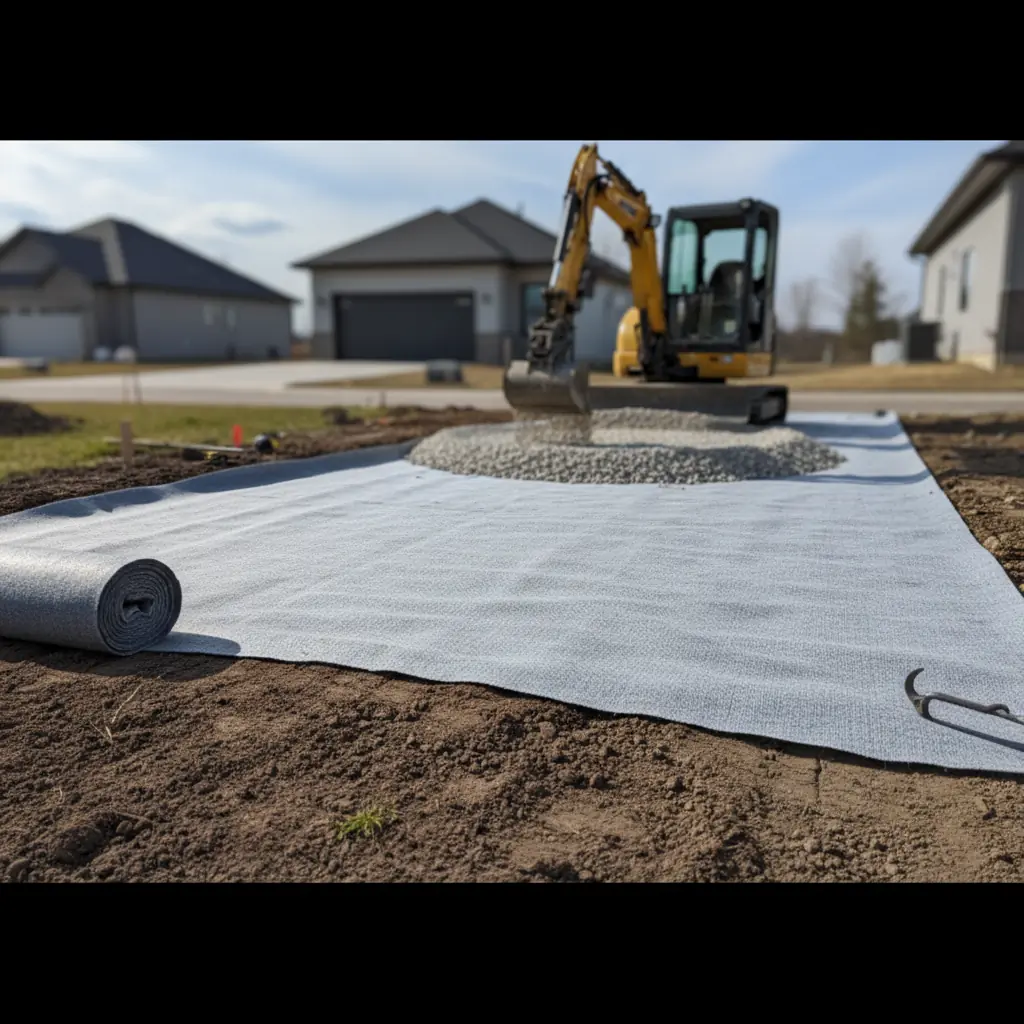
Installing a driveway is a significant investment, and its longevity depends heavily on what lies beneath the surface. Geotextile fabric (also called driveway fabric or separation fabric) is a key component in modern driveway construction. It separates the aggregate base from the underlying soil, prevents mixing, improves load distribution, and reduces rutting. But how much fabric do you need? This guide explains everything you need to know to calculate the right amount, including overlaps, roll sizes, and installation tips.
✨ Results based on standard overlaps. Add extra for curves or waste. ✨
What is Geotextile Fabric and the rationale for using it under a Driveway?
Geotextile fabric is a permeable textile used in construction. Under driveways, it performs several essential functions.
Separation: Stops aggregate from mixing with subsoil. Without it, stone can sink, causing potholes and instability.
Stabilization: Distributes loads more evenly, reducing rutting and extending the driveway’s lifespan. Filtration: Allows water to pass through while retaining soil particles, improving drainage, and preventing pumping action under traffic.
Reinforcement: Adds tensile strength to the soil‑aggregate system, especially in soft or sopping conditions.
For residential driveways, non‑woven geotextile fabric (typically 4 oz to 6 oz per square yard) is the most common choice. It’s durable, easy to use, and effective.
Why does accurate calculation matter?
Ordering the right amount of geotextile fabric is important for three reasons.
Cost efficiency: You buy fabric by the square foot, yard, or roll. If you underestimate, you’ll need a second trip. If you overestimate, you waste money.
Proper coverage: The fabric must extend the full width of the driveway and have adequate overlap between strips. Gaps can lead to puny spots.
Installation ease: Knowing the number of strips you need and how much linear footage to order helps you plan the layout and avoid excessive waste.
The Math Behind Geotextile Fabric Calculation.
Step 1: Measure Your Driveway.
Length: Measure from the road or starting point to the end of the driveway (in feet).
Width: Measure the widest point of the driveway (in feet). Whether the driveway tapers, use the average width, or calculate sections separately.
Step 2: Understand Fabric Roll Dimensions.
Geotextile fabric comes in rolls of various widths and lengths. For driveways, common widths are 12.5 feet and 15 feet. Roll lengths can range from 100 feet to 360 feet or more. You’ll need to know:
Fabric width (in inches or feet – we’ll use inches for precision).
Roll length (in feet) – optional, instead helpful for estimating the number of rolls.
Step 3: Account for Overlaps.
When placing multiple strips side by side, you must overlap the edges to ensure continuous coverage. Industry standards recommend an overlap of 12 to 18 inches. For most residential driveways, 12 inches (1 foot) is usually enough. In soft soil conditions or where heavy traffic is expected, use 18 inches.
The overlap reduces the effective coverage width of each strip. If your fabric width is WW inches and the overlap is OO inches, the effective coverage width per strip is:
Divide the driveway width by the effective width, then round up to the nearest whole number:
Number of strips = ⌈Driveway width (ft) / Effective width (ft)⌉.
Rounding up ensures full coverage.
Step 5: Work out the total linear feet of Fabric.
Each strip matches the full driveway length:
Total linear feet = number of strips × driveway length (ft).
Step 6: Determine Total Fabric Area.
Fabric is mainly sold by the square yard or square foot. To find the total area of fabric you’ll need:
Total area (sq ft)=Total linear feet×Fabric width (in) 12. Total area (sq ft)=Total linear feet×12Fabric width (in).
If you prefer square yards, divide by 9.
Step 7: Estimate Number of Rolls (Optional).
Supposing that you know the roll length, you can determine the method by which many rolls to purchase:
Number of rolls=⌈Total linear feet/Roll length (ft)⌉Number of rolls=⌈Roll length (ft)Total linear feet⌉.
This assumes you can cut each strip from the roll without significant waste. If your driveway is longer than the roll length, you’ll need to join strips end-to-end with an extra overlap (typically 1–2 feet). In that case, add one extra overlap per join when calculating total linear feet. For simplicity, many homeowners buy a roll longer than the driveway.
Example Calculation
Let’s walk through a typical driveway.
Driveway length: 80 ft.
Driveway width: 12 ft.
Fabric width: 12.5 ft (150 inches).
Overlap: 12 inches
Roll length: 300 ft (optional).
Step 1 – Effective width:(150−12)/12=138/12=11.5(150−12)/12=138/12=11.5 ft.
Step 2 – Number of strips:⌈12/11.5⌉=⌈1.043⌉=2⌈12/11.5⌉=⌈1.043⌉=2 strips.
Step 3 – Total linear feet:2×80=1602×80=160 linear ft.
Step 5 – Number of rolls (300‑ft roll):⌈160/300⌉=1⌈160/300⌉=1 roll (you’ll have plenty left over).
Supposing that you had a shorter roll, say 100 ft, you’d need ⌈160/100⌉=2⌈160/100⌉=2 rolls.
Factors That Can Affect Your Estimate.
Driveway shape: Curved or irregular driveways may require more fabric and careful cutting. Consider ordering 10‑15% extra for waste.
Soil conditions: Very soft ground may need wider overlaps or an extra fabric layer.
Fabric type: Woven fabrics vary in strength and may be installed with different overlap requirements. Without fail, follow manufacturer recommendations.
Installation method: If you plan to overlap at the ends as well (e.g., for very long driveways), add an extra 2 ft to each overlap.
Tips for Buying and Installing Geotextile Fabric.
Choose the right fabric: For most driveways, 4 to 6 oz per square yard is enough. Heavier fabrics (8 oz+) are suitable for heavy-duty use.
Buy from an environmental or construction supplier – they can advise on the best product for your soil type.
Prepare the subgrade: Remove vegetation, grade, and compact the soil before installing the fabric.
Stake or weigh down overlaps to prevent shifting during aggregate placement.
Cover promptly: Once the fabric is down, spread the base material immediately to avoid UV damage (most fabrics are sensitive to UV exposure).
Use sharp knives: Cut fabric with a sharp utility knife and use a straightedge for long cuts.
Frequently Asked Questions.
Q: Can I use space fabric instead of geotextile?
A: Space fabric is generally lighter and not designed for load‑bearing applications. For driveways, you need a woven or nonwoven geotextile that meets the required strength specifications.
Q: Is the manner in which much overlap is enough?
A: 12 inches is standard. In flexible soil or under massive traffic, increase to 18 inches. For immensely steady ground, 6 inches might suffice; it’s better to err on the side of caution.
Q: Do I need fabric on the condition that I have a thick gravel base?
A: Yes. Even a thick base can sink into doughy soil over time. Fabric prevents this and improves performance.
Q: Can I install fabric myself?
A: Absolutely. It’s a straightforward DIY project. Just lock in the ground that’s been prepared, and you’ll have help handling large rolls.
Q: The system, how do I account for curves?
A: For gentle curves, you can cut the fabric to follow the shape. For sharp curves, you may need to make relief cuts and overlap more. Add 10% to your estimate.
Q: What about driveways with a slope?
A: The calculation is the same. On steep slopes, you may need to pin the fabric more often to prevent it from sliding.
Conclusion
Geotextile fabric is a trivial investment that pays huge dividends in driveway longevity. By accurately calculating the amount needed – accounting for overlaps and fabric width – you can avoid waste and lock in a professional‑quality installation. Use the calculator below to instantly determine the amount of fabric you need for your specific driveway dimensions.
This guide is for informational purposes. Always consult a geotechnical engineer or local supplier for project-specific advice.