
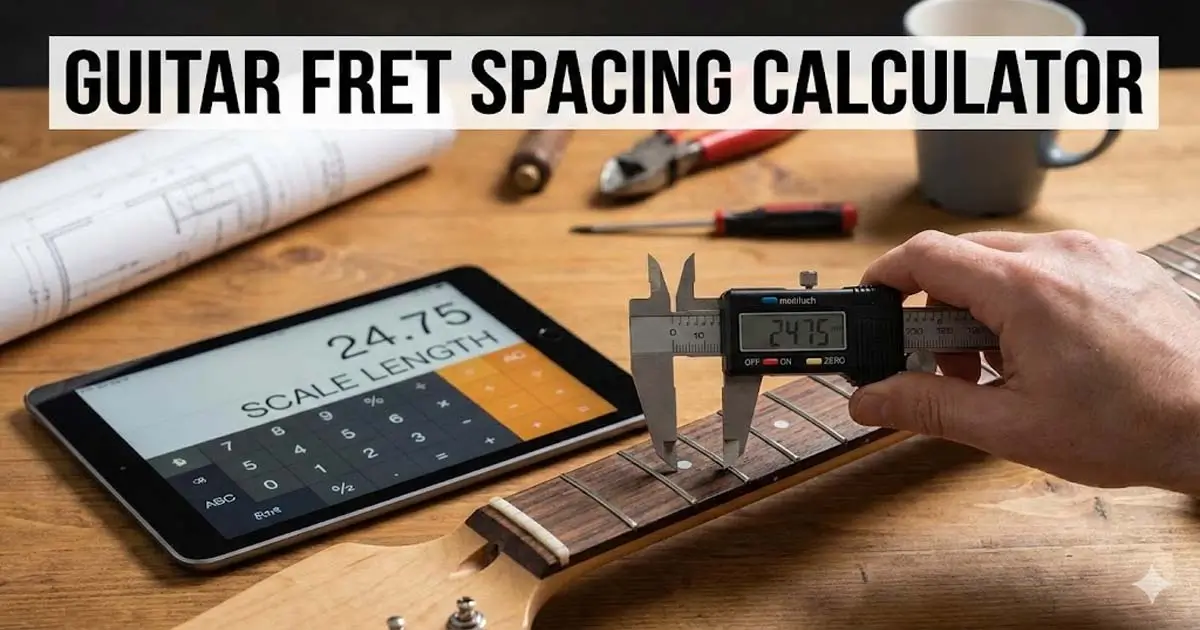
Have you ever wondered why frets on a guitar are placed at seemingly random distances? The precise placement of frets is what allows a guitar to play in tune across the entire neck. This is governed by the physics of vibrating strings and the mathematics of equal temperament. Whether you’re building a custom guitar, repairing a vintage instrument, or just curious, understanding fret spacing is essential. This guide explains the theory, the formulas, and provides a handy calculator to compute fret positions for any scale length.
| FRET | DIST. FROM NUT (IN) | DIST. TO BRIDGE (IN) | DIST. FROM NUT (MM) | DIST. TO BRIDGE (MM) |
|---|
Why Fret Spacing Matters
When you press a string against a fret, you shorten the vibrating length of the string, raising its pitch. For the guitar to play in tune, each fret must be positioned so that the pitch increases by exactly one semitone (half step) as you move up the neck. In modern Western music, we use 12‑tone equal temperament, where the octave is divided into 12 equal semitones. The frequency ratio for a semitone is the 12th root of 2, approximately 1.059463.
This means that the vibrating length of the string must be reduced by this factor for each fret. Starting from the open string length (the scale length), the distance from the nut to the first fret is calculated so that the remaining string length is the open length divided by that ratio. Then the second fret is placed relative to the first, and so on.
Read More: Ceramic Glaze Batch Calculator
The Rule of 18 (and the Real Constant)
Historically, luthiers used a simple approximation: divide the scale length by 18 to get the first fret position, then subtract that from the remaining length and divide again, etc. This “rule of 18” actually uses the constant 17.817, because:11−2−1/12≈17.8171−2−1/121≈17.817
So the correct formula for the distance from the nut to the nth fret is:dn=L(1−2−n/12)dn=L(1−2−n/12)
where LL is the scale length (the vibrating length of the open string). For example, with a 25.5″ scale (common on Stratocasters), the 12th fret (octave) should be at exactly half the scale length:d12=25.5×(1−2−1)=25.5×(1−0.5)=12.75″d12=25.5×(1−2−1)=25.5×(1−0.5)=12.75″ which is exactly the midpoint – as expected.
Alternatively, you can compute fret‑to‑fret distances by repeatedly dividing the remaining string length by 17.817. This iterative method was used by luthiers before calculators.
Step‑by‑Step Calculation
Let’s calculate fret positions for a 25.5″ scale, 22 frets, using the formula.
- Scale length: L=25.5L=25.5 inches.
- Fret number nn from 1 to 22.
- Distance from nut:dn=25.5×(1−2−n/12)dn=25.5×(1−2−n/12)For n=1n=1: 2−1/12≈0.9438742−1/12≈0.943874, so d1=25.5×(1−0.943874)=25.5×0.056126≈1.431d1=25.5×(1−0.943874)=25.5×0.056126≈1.431 inches.
For n=2n=2: 2−2/12=2−1/6≈0.8908992−2/12=2−1/6≈0.890899, d2=25.5×(1−0.890899)≈2.781d2=25.5×(1−0.890899)≈2.781 inches.
And so on.
These positions are measured from the nut toward the bridge. The 12th fret should be exactly 12.75″, confirming the octave.
If you prefer working in millimetres, simply use the same formula with the scale length in mm. A typical Gibson scale is 24.75″ ≈ 628.65 mm.
Accuracy and Compensation
The formula above gives the theoretical fret positions for a perfect string. In practice, several factors require slight adjustments:
- String stiffness: Thicker, stiffer strings don’t follow the ideal physics exactly, especially near the nut.
- Action height: Pressing the string to the fret stretches it slightly, raising the pitch. To compensate, luthiers often place the saddle slightly farther back (intonation adjustment).
- Nut compensation: Some builders cut the nut slightly forward to improve open string tuning.
The fret positions themselves, however, are almost always cut exactly according to the theoretical formula, and intonation is corrected at the bridge. So the calculator below gives the standard fret positions used by virtually all guitar manufacturers.
Using the Calculator
Our simple calculator lets you input:
- Scale length – the distance from the nut to the bridge saddle (in inches or mm). This is the vibrating length of the open string.
- Number of frets – typically 20, 21, 22, or 24.
- Unit – inches or millimeters.
The calculator will display a table of fret numbers and their distance from the nut. You can use these measurements to mark fret positions on a fretboard, verify an existing guitar, or design a custom neck.
Important: Always measure from the nut toward the bridge. If you’re cutting fret slots, you’ll need a very accurate saw and a template or CNC.
Frequently Asked Questions
Q: What is the standard scale length for electric guitars?
A: Common scales: Fender Stratocaster/Telecaster: 25.5″; Gibson Les Paul: 24.75″; PRS: 25″. Basses often use 34″ or 35″.
Q: Why does my guitar have a different scale length?
A: Scale length affects tension and tone. Longer scales (25.5″) have higher string tension and brighter tone; shorter scales (24.75″) feel slinkier and have a warmer tone.
Q: Can I use the same formula for bass guitar?
A: Absolutely. Bass guitars use the same equal‑temperament formula. Just enter the correct scale length.
Q: What about multiscale (fanned fret) instruments?
A: Fanned frets have two different scale lengths for different strings. This calculator is for standard straight frets. For multiscale, each string would need its own calculation.
Q: How accurate do I need to be?
A: Fret positions must be accurate to within a few thousandths of an inch for good intonation. For DIY, use a precise ruler and a sharp saw; better yet, use a pre‑slotted fingerboard or a CNC service.
Q: Where do I measure from – the nut or the fretboard edge?
A: Always measure from the nut (the side of the nut facing the fretboard). The nut is the starting point of the vibrating length.
Why Use a Calculator?
Calculating fret positions manually is tedious and error‑prone. Our calculator gives you instant, precise results for any scale length and number of frets. Whether you’re a luthier, a hobbyist, or a curious guitarist, this tool takes the math out of fret layout.
This guide is for informational purposes. Always verify measurements with a reliable source before cutting an expensive fingerboard.