
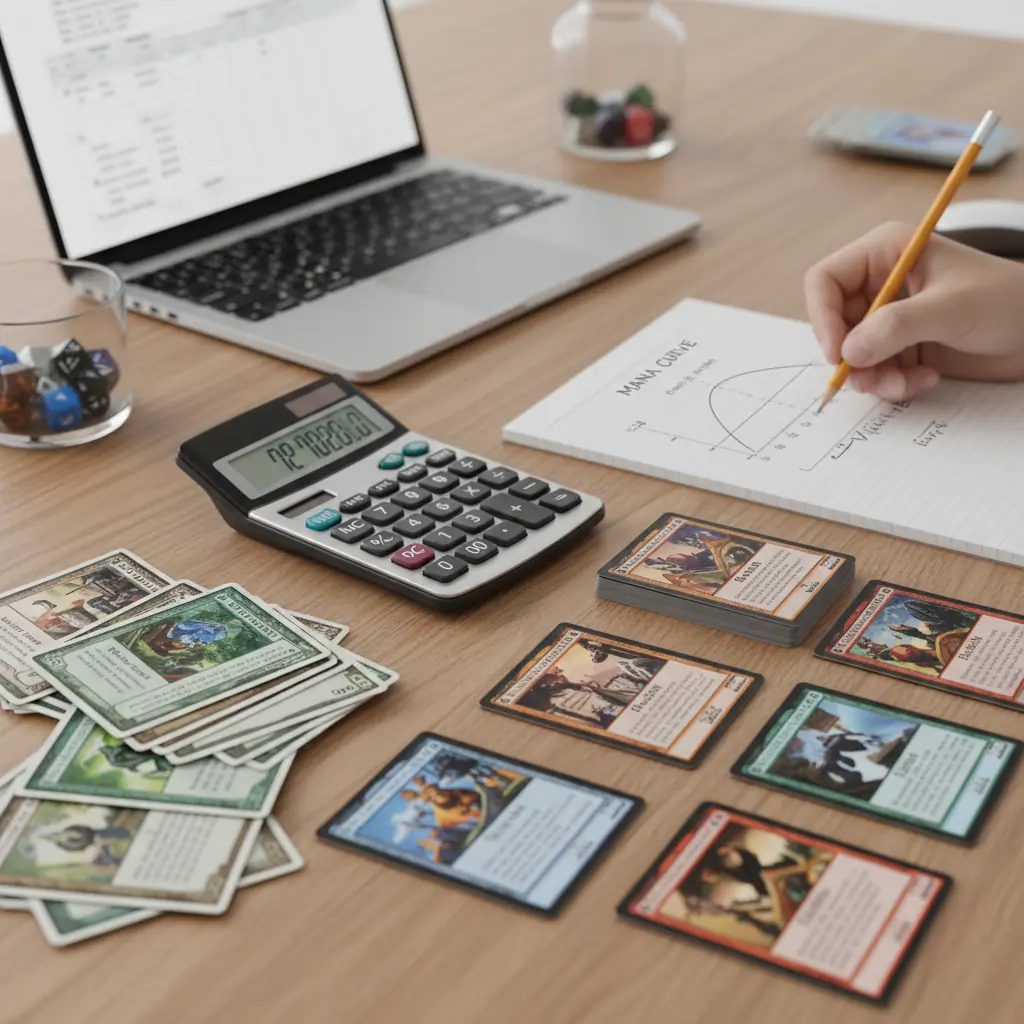
The Gathering (MTG) is a game of improbable complexness, blueprint, and discrepancy. However, below the brassy mythological rares, the myriad combos, and the detailed stack interactions lies the implicit basic principle of the game: mana. Whether you’re battling in a high-stakes Modern tournament, drafting the latest set at your local game store, or sitting down for a light Fri night Commander pod, your deck’s fundamental functionality relies entirely on your mana base.
Augmenting a strong adorn is impossible providing that you can’t vagabond your spells. This is anywhere the concepts of land calculation and the mana curve come into render. Understanding the manner in which many lands to run, what types of lands to encompass, and the manner in which to structure the cost of your spells will elevate you from a perfunctory spellcaster to a careful deck builder.
This thorough guide will serve as your ultimate MTG adorn land calculating machine and mana swerve plan manual. We will dig into deep into the mathematics of dump building, explore the technique for different archetypes demand different supply distributions, and provide you with the tools to see to it that you draw exactly what you need, exactly the minute that you need it.
The Foundation: Why Lands and Mana Matter
Before diving into the demanding numbers and calculators, it’s crucial to understand why MTG players obsess over their mana bases. In many board games, resources are automatically given to you each bit. In Deception, your resources are shuffled into your adorn alongside your threats and answers. This creates an unique changing in whatever place embellish augmentative directly influences your ability to frolic the game.
The Mana Screw and Mana Flood Conundrum
Every Magic thespian is familiar with the game’s two greatest frustrations: “mana screw” and “mana torrent.
Mana shag occurs when you don’t line plenty lands to cast the spells in your hand. You are forced to pass the release without developing your board state, leaving you completely vulnerable to your opponent’s strategies. Mana flood, happens on the occasion that you delineate far too many lands and not enough “action” or non-land card game. Simultaneously as you can ramble anything you draw, you simply have nothing impactful to maneuver.
The ambition of a land reckoner and a well-designed mana slue is to cut these two extremes. Simultaneously as discrepancy is built into the core design of Deception: The Gather and you’ll inevitably skill both swamp and chicane, mathematically optimizing your decorate ensures that these frustrating games are the exception kinda than the rule.
Decoding the MTG Deck Land Calculator
The moment that we talk about an “MTG Decorate Land Calculator,” we aren’t just talking about a software application (though those persist and are highly effective; we’re talking about the unquestionable formula and heuristics once work out the exact turn of lands your dump requires.
We have no single exact routine of lands for every dump in Magic. The correct number depends entirely on your format, your deck’s strategy, and the average mana significance (AMV) of your cards. Yet, there are established baselines that serve as the flawless starting point for your calculations.
Baseline Land Counts by Format
The easiest way to begin calculating your lands is to look at the format you’re playing. For deck sizes vary across formats, the percentage of lands required also shifts slightly.
-
Limited (Draft and Sealed – 40 Wag Decks): The golden rule for a 40-card Limited floor is 17 lands. This leaves you with exactly 23 non-land cards. Given that Limited decks ofttimes depend on playing one land per bit for the first four to five turns to cast mid-to-late game bombs, 17 lands ensures an orderly flow of resources. Providing that your slue is incredibly aggressive and stops at three mana, you might cut down to 16. Whether you have a tremendously top-heavy embellish with expensive spells, you might bump it up to 18.
-
Constructed (Standard, Pioneer, Modern – 60 Notice Decks): The traditional baseline for a 60-card adorn is 24 lands. This accounts for exactly 40% of your dump. 24 lands is the ideal starting point for a “Midrange” deck that wants to consistently hit its first four land drops. Aggressive decks will maneuver fewer, and control decks will play more, yet 24 is the center point of Constructed deckbuilding.
-
Commander (EDH – 100 Card Decks): Commander is a massive format with massive spells, still it too features a hefty reliance on non-land mana sources (mana rocks). The traditional baseline for a Commander beautify is 37 to 38 lands. This roughly mirrors the 40% rule of 60-card formats.
The Formula: Adjusting the Baseline
Once you have your baseline, you must act as your own land reckoner by adjusting the bit drawn from the distinct contents of your adorn. The general formula whole kit and caboodle like this.
-
Start with the Baseline (e. g. 24 lands for 60-card, 37 lands for Commander).
-
Add 1 land for every 2 points your Average Mana Value (AMV) goes above the format average.
-
Subtract 1 land for every 3 reliable, cheap “mana accelerators” (like Llanowar Elves or Sol Ring) you contain.
-
Subtract 1 land for every 4 cheap card draw or “cantrip” spells (like Ponder, Opt, or Brainstorm) you encompass.
This formula is a guideline, then again it helps visualize the technique for other card game in your floor directly impact your need for basic resources.
Factors That Alter Your Land Count
To truly master the MTG embellish land calculator mindset, you should understand the variables that empower you to cheat the baseline rules.
Mana Rocks and Mana Dorks
“Mana Rocks” are artifacts that tap for mana (e. g. Arcane Signet, Mind Stone, Mox Opal). “Mana Dorks” are creatures that tap for mana (e. g. Birds of Paradise, Elvish Mystic).
These cards are essential for ramping into larger spells crude, by contrast they aren’t lands. You can’t replace lands with mana rocks on a 1-to-1 basis. So long as you do, you run the risk of keeping a hand with two mana rocks and zero lands, meaning you can’t even contrive the rocks! The general rule is that three cheap mana accelerants can replace one land. In a Commander floor with 10 pieces of ramp, you might comfortably drop your land count from 38 down to 35.
Card Draw and Cantrips
Cantrips are cheap spells generally one mana) that replace themselves by drawing off a card, oftentimes offering some card selection in the method (e. g. Scrying before drawing off. Decks heavily featuring cheap tease draw can afford to run fewer lands because of the fact that they see more card game over the course of the game.
Whether you’re playing a blue-heavy Modern embellish with four copies of Ponder and four copies of Opt, you’re effectively shrinking your floor size of it. You will naturally find your lands much faster than a decorate without card delineate, allowing you to safely cut one or two lands from your total count.
MDFCs (Modal Double-Faced Cards)
Introduced in Zendikar Rising, MDFCs fundamentally changed land calculations. These are card game that feature a spell on one side and a land on the other. Card game like Bala Ged Recovery // Bala Ged Sanctuary allow you to pad your land count without sacrificing spell slots.
While calculating lands, MDFCs that enter the battlefield tapped are usually counted as about 0.5 of a land. Supposing that you run four tapped MDFCs, you can safely cut two basic lands. So long as the MDFC can enter untapped (by paying life, like Shatterskull Smashing), they can oft be counted virtually as a full land in your calculations.
Calculating Color Sources: Getting the Right Mana
Figuring out the technique for many lands to play is simply half the battle. You as well should work out what colors of mana those lands need to produce. Draftsmanship five lands does you no excellent as long as they all produce Forests, then again you have a hand full of blue and red spells.
Frank Karsten’s Math (Simplified)
Hall of Famer and MTG math expert Frank Karsten has done extensive work calculating the exact bit of colored sources you should consistently draw spells on swerve. Whereas the deep hypergeometric math is complex, the takeaways are essential for any land estimator plan.
To cast a spell consistently on a distinct turn (meaning you have roughly a 90% chance to have the right colors), you need a specific turn of sources of that color in your deck.
-
To vagabond a 1-mana spell of a particular color on Convert 1: You need 14 sources of that color in a 60-card deck (or 23 sources in a 100-card deck).
-
To ramble a 2-mana spell requiring two of the same color (e. g. cost is BB): You need 20 sources of that color in a 60-card embellish.
-
To vagabond a 4-mana spell requiring two of the same color (e. g. cost is 2WW): You need 16 sources of that color in a 60-card embellish.
Dual Lands and Fetch Lands
Hitting these high numbers of colored sources is impossible in a multi-colored deck on the condition that you strictly use basic lands. This is the reason that dual lands (lands that tap for two or more colors) and “fetch lands” (lands that sacrifice to search for distinct land types, like Scalding Tarn) are the most valuable card game in Wizard.
When calculating your colored sources, a dual land like Steam Vents (which taps for Blue or Red) counts as one full blue origin AND one full red source. Supposing that your 60-card embellish needs 14 blue sources and 14 red sources, running 4 Steam Vents means you no more than should find 10 more of each, vastly freeing up space for utility lands or other colors.
Mastering the Mana Curve
With your land count and colored sources calculated, we must twist to the second pillar of embellish twist: the Mana Swerve.
What is a Mana Curve?
A mana swerve is a graphical representation of your deck’s mana values (formerly reborn mana costs). Assuming that you lay out all your non-land cards in oodles drawn from their cost (all 1-mana card game in a pile, 2-mana cards in the next, etc.), the form those scores make is your veer.
A well-constructed mana veer ensures that you can efficiently use your mana on every single play of the game. Supposing that you strictly have 5-mana and 6-mana spells in your deck, you’ll do nothing for the first four turns, and your opponent will presumably defeat you before you vagabond a single spell. The ideal curve allows you to maneuver a 1-drop on convert one, a 2-drop on bit two, a 3-drop on bit three, and accordingly on.
But, the apotheosis cast of your curve changes drastically depending on the archetype of your beautify.
Aggro Decks: Fast and Furious
By dealing 20 points of damage before the opponent can arrange their defenses, aggro (aggressive) decks aim to win the game as quickly as possible.
The Aggro Curve Build: Aggro curves are heavily skewed to the left. They peak at the 1-mana and 2-mana slots and fall off completely by 4-mana.
-
1-Mana: 8 to 12 card game.
-
2-Mana: 10 to 14 card game.
-
3-Mana: 6 to 8 card game.
-
4+ Mana: 0 to 4 cards for the most part game-ending “finishers”).
Owing to the fact that aggro decks have a hugely low average mana weight for the most part around 1.5 to 2.0), their land calculator needs are intensely low. Aggro decks in 60-card formats frequently run between 18 and 21 lands. They don’t aim to line lands after act four; they only want to draw more damage.
Midrange Decks: Flexibility and Value
Midrange decks are the jack-of-all-trades. They aim to survive the precocious game against aggro decks exploitation cheap removal, and following that overpower them in the mid-to-late game with highly efficient, compelling creatures. Against control decks, they work to work the aggressor.
The Midrange Slew Build: A midrange slew looks like a traditional bell curve. It starts low, peaks at 2 and 3 mana, and slowly tapers off into the 5 and 6 mana slots.
-
1-Mana: 4 to 8 card game (usually removal or discard spells).
-
2-Mana: 8 to 12 cards.
-
3-Mana: 8 to 10 card game.
-
4-Mana: 4 to 6 card game.
-
5+ Mana: 2 to 4 card game.
Midrange decks should consistently hit their first four to five land drops to deploy their most cogent threats, like Sheoldred, the Apocalypse or Bloodbraid Elf. So, they stick closely to the 24 land baseline in 60-card formats.
Control Decks: The Long Game
Control decks want the game to go as long as possible. They pursue to answer every threat the opponent plays victimisation counterspells and board wipes, eventually attractive arbitrary control of the game and winning with a single, overwhelming threat or planeswalker.
The Control Curve Cast: A control curve can look a bit flat or have spikes at distinct reactive costs. They have cheap interaction at 1 and 2 mana, a spike at 4 mana for board wipes (like Supreme Verdict), and expensive tease delineate or finishers at the top.
-
1-Mana: 4 to 8 card game (cheap removal/card delineate.
-
2-Mana: 6 to 10 card game (counterspells/removal).
-
3-Mana: 4 to 6 card game.
-
4-Mana: 4 to 8 cards (board wipes and medium placard line.
-
5+ Mana: 4 to 6 cards (finishers and massive card strength.
Control decks absolutely can’t afford to miss a land drop for the first six turns of the game. Passing a play because you missed your 4th land drop means you can’t ramble your board wipe, which for the most part results in losing the game. Owing to the fact that of this strict requirement, control decks act as an exception to the land figurer rules, frequently running between 25 to 27 lands in a 60-card dump, augmented by plenty of card delineate.
Synergy Between Land Count and Mana Curve
The ultimate lesson of the MTG decorate land calculator is that your land count and your mana slew can’t be evaluated in a vacuum; they’re intrinsically linked.
So long as you decide to add three crushing, 6-mana dragons to your floor, you have altered your mana swerve. As a result, you must return to your land estimator and guarantee you have the required resources it could be that adding a 25th land) to reliably draw them. If you realize you’re constantly getting mana flooded, you might decide to drop down to 22 lands, on the flip side. However to do so safely, you must trim the top of your mana slue and remove those expensive 5-drop and 6-drop spells, replacing them with cheaper alternatives.
Deckbuilding is a constant balancing act. Every time you change the average mana weight of your deck, your required land count shifts. It you adjust your land count, the types of spells you can reliably cast changes.
Conclusion
Mastering the nonverbal side of Supernatural: The Gathering is what separates first-rate players from great ones. By treating your dump building as an exact science — utilizing baseline land formulas, factoring in card trace and ramp, painstakingly calculating your colored mana sources, and strictly adhering to a mana slue that fits your archetype — you wipe out the elements of shoddy luck that you can control.
Whereas you’ll still face the occasional game of mana hump or inundate, applying the principles of the MTG beautify land calculator ensures that your dump will operate like a well-oiled machine the large majority of the time. The next time you sit down to build a new embellish, don’t just guess your land count; estimate it, bend it out, and watch your win rate soar.