
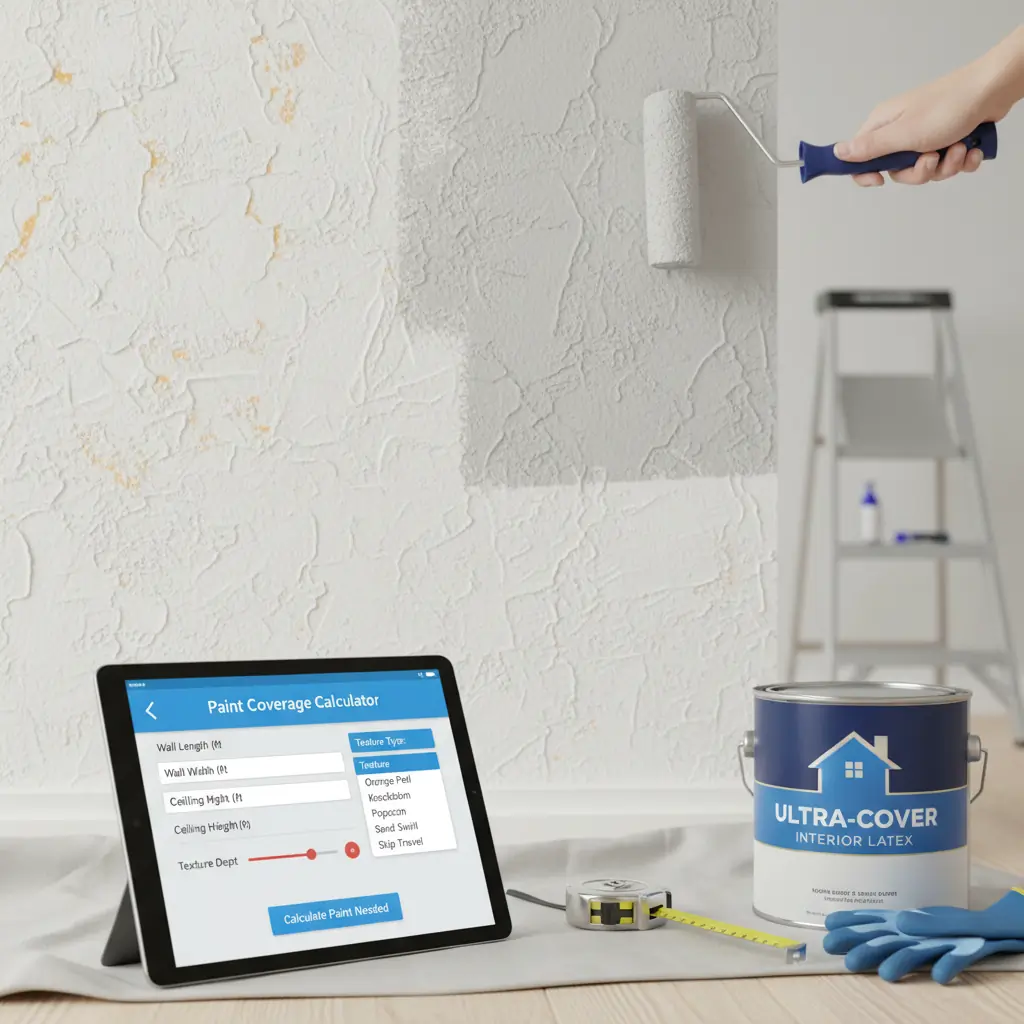
Do you have the motivation to work out how much? paint To buy for your textured walls — use our. paint coverage calculator For rough walls! It’ll support your idea of the amount. paint needed for you. painting project, delivery, you clip, and money.
Paint Coverage Calculator
Enter your room dimensions and texture type to estimate how much paint you need.
Calculation Results
Use Our Paint Calculator for Textured Walls
Our Paint Coverage Calculator [Product] takes the guesswork out of it. painting project [Concept] It’s intentional to partake in the incomparable challenges presented by. textured walls [Key Concept] Ensuring you get the appropriate amount of. paint [Key Concept] No more, no less.
Enter Your Room Dimensions
You’ll need precise measurements — measure. length [Concept] and width [Concept] of each fence in feet or meters — afterwards, gauge . ceiling height [Concept] Input these dimensions into the calculating machine. Accurate measurements are key to getting the right forecast. Don’t just eyeball it! As an example, so long as your room is 12 feet long, 10 feet wide, and has an 8-foot ceiling, enter those values into the computer. paint calculator [Key Concept] Uses these values to determine . wall area [Concept] .
Account for Texture Depth and Type
Textured walls aren’t flat, so you need to account for the extra. surface area [Key Concept] Our calculator allows you to decide on the case of the texture you have, like. orange peel texture [Texture Type] , knockdown texture [Texture Type] , popcorn texture [Texture Type] , sand texture [Texture Type] , or skip trowel. Each texture has an antithetical depth, which affects how much. paint You’ll want — for the model. popcorn texture requires significantly. more paint than A light. orange peel texture. The estimator adjusts . paint consumption [Concept] Supported on your selection.
Calculation Results: Paint Needed
Once you’ve entered your dimensions and selected the texture case, the computer will present a forecast: paint volume [Key Concept], in gallons [Concept] or liters [Unit of Measurement]. The results will depict the total. paint Required for one or two. coats [Concept] It’s perpetually a good idea to buy a little extra to account for touch-ups or spills. For example, if the reckoner says you need 2.8 gallons, it’s best to buy 3. gallons .
Understanding Paint Coverage for Textured Surfaces
Paint coverage [Key Concept] refers to the area . A gallon of paint can address. But, this. paint coverage varies greatly depending on . surface texture [Concept] That’s why a standard. The paint calculator may not be exact. textured walls .
Why Textured Walls Require More Paint. Textured walls have an uneven texture.ven. surface, which increases the total. surface area Next to polished. interior walls [Concept] Think of it like this: a flat piece of paper has less. surface area than the same piece of paper crumpled into a ball. The nooks and crannies of. Textured walls require more paint to adequately cover them. This is what prompted . Paint Coverage Calculator [Product], particularly studied for. Textured walls are a must.
Average Paint Coverage Rates on Different Textures
The average paint coverage per gallon on polished walls is about 350-400. square foot [Unit of Measurement] On the other hand, on. textured walls. That bit decreases significantly. Here are some examples.
Orange Peel
Orange peel texture [Texture Type] reduces paint coverage to around 300-350. square feet per gallon .
Knockdown
Knockdown texture [Texture Type] further reduces. paint coverage to 250-300. square feet per gallon .
Popcorn
Popcorn texture [Texture Type] Frequently found on ceilings) can minimize. paint coverage to as little as 200-250. square feet per gallon .
Sand Swirl
Sand Swirl Texture has a paint coverage of 275-325. square feet per gallon .
Skip Trowel
Skip Trowel Texture is one of the heavier textures, with a rating of 225-275. square feet per gallon .
These numbers are just estimates—the actuals. Paint coverage will depend on the particular texture. paint quality [Concept] And . application method [Concept] .
How to Manually Calculate Paint Needed for Textured Walls
You can. Calculate paint need manually, or it’s more complex. measure the total. wall area [Concept] Ultimately, appraisal . texture factor. This is a percentage that represents the increase in surface area, for demonstration. orange peel texture May have a texture ingredient of 15%, whereas. popcorn texture May have a texture variable of 50% — multiply . wall area using the texture factor to get the adjusted value. surface area Divide the adjusted. surface area. paint coverage rate (usually around 350 square feet per gallon for polished walls) to get . gallons Needed. This method is less exact than using our own. paint calculator .
Factors Affecting Paint Coverage on Textured Walls
Respective factors drive. paint coverage on textured walls. Agree on these factors to help you get a more accurate appraisal.
Texture Type and Depth
As mentioned earlier. Texture type and depth significantly influence. paint consumption Deeper textures require. more paint than Lighter textures. texture profile [Technical Term] plays a key role.
Paint Quality and Type
Paint quality, on top of that, matters. Premium Paint [Product] typically has a break. paint coverage and hiding power than. Economy Paint [Product] The typewrite of. Similarly, paint affects. paint coverage, as an example. latex paint [Paint Type] Generally covers more area than. oil-based paint [Paint Type] . Also, self-priming paint [Product Name] may reduce the figure of. coats needed.
Application Method (Brush, Roller, Sprayer)
The application method affects paint coverage . Spraying [Concept] is typically used. More paint than rolling [Concept] Owing to the fact that some paint is lost in the air. Brushes [Product] are best for detailed functions and edges, but they can take longer and may not provide as true a result. paint coverage as rollers [Product] . Rolling [Concept] is the most everyday way. interior walls [Concept] .
Number of Coats
The number of coats you apply will obviously affect the total. paint Needful, most. painting projects [Concept] Take at least two. Coats for full. paint coverage. Above all, on the occasion of changing colors or painting over existing ones. textured walls. If you’re exploiting a high-quality. paint, and the existing color is similar, you might get away with one. coat .
Wall Porosity and Priming
Wall Porosity refers to the extent to which the bulwark is absorbent. Textured walls can be more porous, which means they absorb more. more paint . Priming [Concept] helps seal. surface , reducing paint absorption, and improving. paint coverage. drywall primer [Product] On modern. Drywall [Material] is essential.
Choosing the Right Paint for Textured Walls
Selecting the right. Paint is essential for achieving top results. textured walls .
Best Paint Types for Textured Surfaces
Assess these paint Types for. textured surfaces :
Latex Paint [Paint Type]: Painless to spotless and durable, making it an outstanding choice for most. interior walls .
- Acrylic Paint [Paint Type]: Offers first-rate adhesion and resistance to cracking, ideal for high-traffic areas.
- Self-Priming Paint [Product Name]: Combines paint and primer in one, saving time and effort.
Primer Recommendations for Textured Walls
- Drywall Primer [Product]: Seals up to date. Drywall [Material] provides a smooth base for. paint .
- Stain-Blocking Primer [Product Name]: Prevents stains from bleeding through and through . paint .
- Primer Sealer [Product Name]: Seals porous. surfaces and improves. paint adhesion [Technical Term] .
Kilz [Product Name] and Zinsser [Product Name] are two fashionable products. primer brands.
Paint Sheen Considerations for Textured Walls
Paint Finish [Key Concept]: the level of shine. paint . Different sheen (paint) [Technical Term] Levels are suitable for disparate areas.
- Flat Finish [Paint Finish]: Hides imperfections well, making it a good alternative for ceilings and low-traffic areas.
- Matte Finish [Paint Finish]: Alike to flat, that said, slightly more durable.
- Eggshell Finish [Paint Finish]: Offers a subtle sheen and is easy to clean, suitable for living rooms and bedrooms.
- Satin Finish [Paint Finish]: More durable and washable than eggshell, making it a choice quality for kitchens and bathrooms.
- Semi-Gloss Finish [Paint Finish]: Highly durable and moisture-resistant, ideal for trim and doors.
- Gloss Finish [Paint Finish]: The most durable and easiest to clean, but it also shows imperfections easily.
- For textured walls , flat or matte Finishes are often preferred because they minimize the appearance of imperfections.
- Priming Textured Walls for Optimal Coverage. Priming [Concept] is an often-overlooked tone; that said, it’s indispensable for achieving the best results the moment that. painting textured walls [Concept] .
Why Priming is Crucial
- Seals . surface , reducing paint absorption .
- Provides a uniform base for. paint , improving paint adhesion .
- Blocks stains and prevents them from bleeding through. paint .
- Assists in pulling off an ordered color.
- Can reduce the issue of. coats of paint needed.
Choosing the Right Primer
Go with . primer That’s appropriate for you. wall surface, and the type of. paint You’re exploitation. As an example, use drywall primer on new drywall. stain-blocking primer, if you have stains to cover.
How to Properly Prime Textured Walls
-
- Clean . Walls to remove dirt, dust, and grease.
- Repair any imperfections, like holes or cracks.
- Apply . primer Even exploitation . brush , roller , or sprayer .
- Enable . primer To serve completely earlier. painting .
Step-by-Step Guide: Painting Textured Walls
Follow these steps for a professional-looking finish on your. textured walls .
Preparation is Key
Proper preparation is key to success. painting project .
-
-
- Gather your supplies. paint , primer , brushes , rollers , tape [Product] , drop cloths [Product] , paint tray [Tool] , and cleaning supplies [Product] .
- Sterile . walls thoroughly.
- Repair any imperfections.
- Tape off trim, windows, and doors.
- Brood the level with. drop cloths .
-
Application Techniques for Textured Surfaces
- Use a roller with a thick nap to reach into the texture’s crevices.
- Apply . paint in thin, even. coats .
- Avoid applying disproportionately much. paint In one area, as this can lead to runs and drips.
- Process in modest sections to check that level. paint coverage .
Tips for Achieving Even Coverage
- Uphold a soggy edge to prevent lap marks.
- Overlap each stroke slightly.
- Use a brush to get into corners and hard-to-reach areas.
- Allow each. coat of paint. To dehydrate completely before applying the next.
Saving Money on Paint for Textured Walls
Painting can be expensive, but unlike this, there are ways to make money.
Accurate Measurement Techniques
Close measurements are the premier pace to deliver money — use our. paint coverage calculator to identify exactly how much. paint you want, and dodge purchasing unreasonably much or excessively little.
Buying Paint in Bulk vs. Individual Gallons
Buying paint in bulk can be cheaper than purchasing individual cans. gallons, especially if you have an ample. painting project Yet, only buy as much as you want, as. Paint can expire.
Utilizing Paint Sales and Discounts
Keep an eye out for. paint sales and discounts at your local home improvement store. Many stores present coupons and rebates. Paint Products. Also, think about purchasing slightly tinted. paint at a discount.
Geotextile Fabric Calculator for Driveway
Addressing Common Painting Problems on Textured Walls
Steady with conscientious preparation, you may encounter some everyday. painting problems.
Avoiding Paint Runs and Drips
Paint runs, and drips can occur when too much is used. Paint is applied in one area. To avoid this, apply . paint in thin, level layers. coats If you do get a run or drip, wipe it off immediately with a damp cloth.
Preventing Uneven Coverage
Uneven paint coverage can result from the victimization of the wrong. application method, or not applying enough. paint Check that to use . Roller with a thick nap; apply paint in thin, even layers. coats .
Fixing Mistakes on Textured Surfaces
Whether you make a mistake, don’t panic. Minor mistakes can be easily corrected with a touch-up. Brush. For bigger mistakes, you may be motivated to sand the area and reapply the coating. paint .
FAQs
Here are some frequently asked questions. painting textured walls .
How much paint do I need for a textured wall?
The amount of paint you need for a textured wall depends on the wall’s dimensions, the texture type, and the paint’s coverage rate. Use our paint coverage calculator to get an accurate estimate.
How many square feet does a gallon of paint cover on textured walls?
A gallon of paint typically covers between 200 and 350 square feet on textured walls, depending on the texture’s depth and the paint’s quality.
Do I need to prime textured walls before painting?
Yes, priming textured walls is highly recommended. Primer seals the surface, improves paint adhesion, and helps achieve a uniform finish.
How many coats of paint should I apply to textured walls?
Two coats of paint are generally recommended for textured walls to ensure full coverage and a consistent color.
What is the best way to paint textured walls?
The best way to paint textured walls is to use a roller with a thick nap, apply thin, even coats, and work in small sections.