
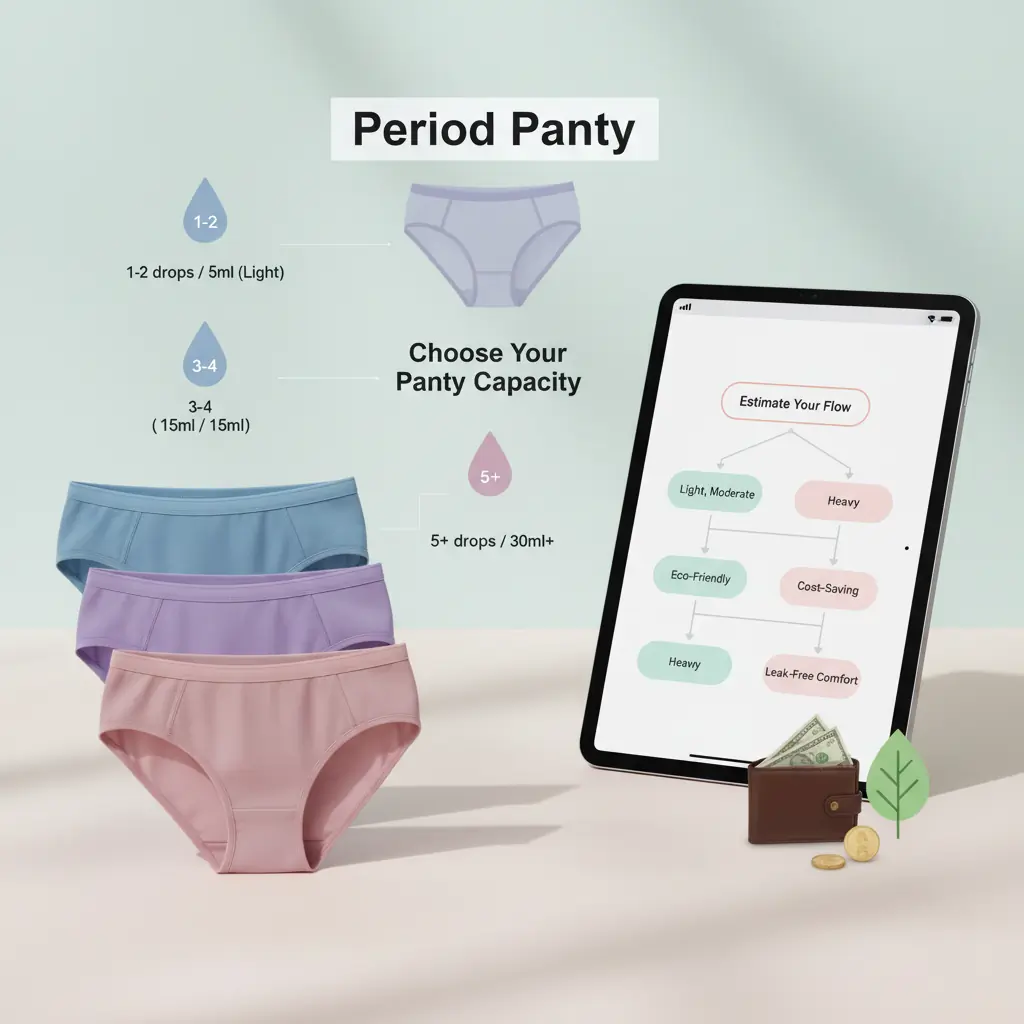
Are you tired of frequent leaks and spending too much on period products? The Period Panty Absorption Calculator can help! This guide will show you how to estimate your flow, choose the right period panties, and save money while being eco-friendly. Let’s find your perfect fit and say goodbye to period woes!
Period Panty Assistant
Estimate your flow capacity needs and see how much you could save!
Estimated Daily Flow: 0 mL (0 oz)
Tip: You can split this total volume across 2 pairs of panties to stay fresh throughout the day.
Initial Investment (Reusable Set): $0
1-Year Savings: $0
3-Year Savings: $0
5-Year Savings: $0
*5-year estimates assume purchasing a fresh set of panties halfway through to maintain peak absorbency and hygiene.
Understanding Period Panty Absorption
Period panties are reusable. period products Designed to absorb catamenial blood, offering an alternative to. disposable pads and tampons. Savvy their. Absorbency is key to a leak-free and homely stage. You’ll aim to consider your. menstrual flow, the panty’s capacity, and your individual needs. At its core, the Period Panty Absorption Calculator helps appraise these factors.
What is Period Panty Absorption Capacity?
Period panty absorption capacity refers to the amount of fluid a pair of pants can absorb. Menstrual panties can hold before leaking. This is mainly measured in milliliters (mL) or ounces (oz). Distinct styles and brands offer varying levels of. Absorbency ranging from insubstantial to bulky flow options — knowing your typical. Menstrual flow is the first phase in choosing the powerful. Panty capacity. While a hefty absorbency panty is designed for your heaviest flow years or overnight use, think of it like this: a buoyant absorbency panty might be suitable for spotting or light years.
How Absorption Levels Are Measured (Drops, mL, oz)
Preoccupancy levels are often indicated using drops. milliliters (mL) , or ounces (oz). You could see labels like “2-drop absorbency” or “holds up to 10 mL”. Here’s a quick conversion to help you interpret.
- 1 drop: around 1-2 mL.
- 1 teaspoon: about 5 mL.
- 1 ounce (oz) is about 30 mL.
Most period panty brands will specify absorbency in mL or oz, making it easier to compare products. Some brands, like Thinx or Modibodi, also provide a visual guide using drops. Remember that these are just estimates, and individual results may vary.
Caffeine Half-Life Calculator
Factors Affecting Your Period Flow & Absorption Needs
Several factors influence your period flow and, in turn, your absorption needs. These include flow intensity, individual body differences, and the time of day.
- Flow Intensity: Light, Moderate, Heavy, Overnight
- Flow intensity is categorized as gossamer, moderate, weighty, or heavy overnight.
- Light flow: Minimal spotting, requiring minimal. absorbency .
- Moderate flow: Noticeable blood flow, requiring moderate absorbency.
- Heavy flow: Significant blood flow, potentially requiring frequent changes or high absorbency.
- Overnight: Typically requires the highest absorbency for extended protection.
Individual Body Differences
Individual body differences like age, hormonal imbalances, and certain medical conditions such as PCOS (Polycystic Ovary Syndrome) or Endometriosis can impact menstrual flow. Some people naturally have heavier or lighter periods than others. Your menstrual cycle’s length and regularity also matter—if you have Menorrhagia (Heavy Menstrual Bleeding), you’ll need period panties with a higher capacity.
Time of Day
Menstrual flow can vary throughout the day. It’s frequently heaviest in the morning and gradually decreases as the day progresses. You power penury higher. Absorbency period panties during flush flow times and lighter. absorbency Options later in the day. Also, consider that you’ll be sitting for long periods or being active.
Period Panty Absorption Calculator: Estimate Your Needs. Ready to find the perfect period panty absorbency for your flow? Our period panty absorption calculator helps you estimate your needs based on your current pad or tampon usage. The calculator uses an algorithm that factors in your flow to pinpoint the best absorbency level.l.
Step 1: Track Your Period Flow for a Day
The premier step is to tail your. Period flow: For at least 1 day, ideally on a day when your flow is heaviest.y. pads or tampons, and how often you change them. Also, consider any. leakage You’re an expert. This data will give a baseline for estimating your boiler suit absorption needs. The period flow tracker will give you insight into how your flow changes throughout the day.
Step 2: Determine Your Average Pad/Tampon Usage.
Next, determine your average. Use a pad or a tampon per day. Whether you use both, figure out the equivalent in either. pads or tampons. As an example, given that you use 3 regular. pads and 2 lights. Tampons, you reckon that’s equivalent to 4 regulars? Pads. Be as precise as possible to get the most reliable recommendation. calculator . .
Step 3: Use Our Calculator to Find Recommended Absorption
Now, use our calculator below to enter your data and find your recommended absorption level. The calculator will ask for information like:
- Average routine of Pads or tampons are used per day.
- Type of pads or tampons Used (light, regular, super, etc.).
- Approximate fourth dimension between changes.
- Any instances of. leakage
Supported by this information, the calculator will offer a recommendation. Absorption Range in milliliters (mL) or ounces (oz), helping you select the right. period panties .
Example Calculation: From Pads/Tampons to Period Panties.
Let’s say you typically use 5 regular pads per day, changing them every 4-5 hours. According to most pad manufacturers, a standard pad holds about 5 mL of fluid. That is why your estimated daily blood volume is 25 mL (5 pads x 5 mL).
Drawn from this reckoning, you would want. period panties With a total. Absorbency of at least 25 mL for a full day’s protection. You might prefer two pairs of. Period panties with 15 mL absorbency each, or one pair with 30 mL absorbency.
Choosing the Right Period Panty for Your Flow
- Selecting the suitable.
- Period panty involves considering style.
- Absorbency Level, and material.
- Sympathy, these factors ensure maximum ease and leak protection.
- Period Panty Styles and Absorption Levels
- Period panties come in diverse styles, each offering unusual levels of. absorbency .
- Briefs, Hipsters, Boy Shorts, Thongs
Briefs: Offer full coverage and are a stellar, tasteful choice for oppressive flow or overnight use.
Hipsters: Offer moderate coverage and are suitable for moderate flow.
Boy Shorts: Offer more coverage than hipsters and are a good option for moderate to heavy flow.
Thongs: Offer minimal coverage and are best suited for light flow or as backup protection.
Light, Moderate, Heavy, Overnight Options
Each style typically comes in delicate, moderate, cumbersome, and overnight. Absorbency Options — match . Absorbency Level to your typical flow to guarantee adequate. leak protection. As an example, you may select. Briefs with overnight absorbency for sleeping and thongs with weightlessness. Absorbency for lighter years.
Material Matters: Absorbent Layers & Co. The materials used in period panties significantly impact their performance. their. absorbency, consolation, and breathability.
Cotton, Bamboo, Microfiber
Cotton: A natural fiber that’s breathable and soft on skin.
Bamboo: Highly absorbent, soft, and eco-friendly.
Microfiber: A synthetic material that’s quick-drying and effective at wicking away moisture. Most period panties have multiple layers: a moisture-wicking top layer, an absorbent core, and a leak-proof outer layer. layer. PUL (Polyurethane Laminate) Look for. antimicrobial Properties to avert odor and bacterial growth.
Finding the Right Fit for Leak-Proof Protection
Finding the good fit is vital. leak-proof protection . Period panties should fit snugly. Measure your hips and waist, then consult the brand’s sizing chart to pinpoint the right size. A well-fitted pair of. Period panties will stay in place and block gaps that can lead to leakage .
The Financial Benefits of Switching to Period PantMenstrual panties can lead to significant issues.ead to significant. financial savings over metering next to constantly purchasing. Disposable menstrual products. Let’s break down the numbers.
Menstrual Panties: A Long-Term Savings Calculator
Use our. Menstrual panties savings calculator. To see the amount of money you can save by switching from. disposable products .
Input: Current Spend on Disposable Products (Monthly/Yearly)
Enter your current monthly or yearly disbursal. disposable pads and tampons. This includes the cost of all. Disposable menstrual products you use regularly.
Input: Number of Period Panties Purchased
Enter the number. period panties. You plan to acquire. A prosperous set typically consists of 5-7 pairs.
Output: Total Savings Over 1, 3, 5 Years
The calculator Will afterwards appraise your total. savings Over 1, 3, and 5 long term, considering the initial investment in period panties, and the ongoing cost of. disposable products .
The Cost of Disposable Menstrual Products. The average person spends between $10 and $20. spends around $10-$20. per month on disposable menstrual products. Over a lifetime, this can amount to thousands of dollars. Period panties require an initial investment, but can last for 2-3 years with proper care, significantly reducing your long-term expenses.
Breaking Down the Initial Investment vs. Long-Term Gains
The initial investment in period panties might seem higher than purchasing a box of. disposable pads. Instead, it’s a one-time cost. A set of 5-7 pairs of. Period panties could, then again, over 2-3 years, you’ll save hundreds of dollars by not having to constantly repurchase. disposable menstrual products . The financial savings add up quickly.
Beyond Savings: TheEnvironment. Besides, financial savings from switching to. Period panties offer big environmental and health benefits.
Reducing Waste: A Sustainable Choice
Disposable menstrual products contribute significantly to. plastic waste . Pads and tampons contain plastics that take hundreds of years to break down. Period panties are reusable, drastically reducing your environmental footprint. re making . sustainable period choice.
Health Considerations: Chemicals & Allergies in Disposables
Disposable pads and tampons can contain chemicals and fragrances that can irritate sensitive skin and potentially disrupt the menstrual cycle. Period panties, especially those made from natural fibers like cotton, can also cause irritation. Cotton or bamboo is often gentler on your skin and reduces the risk of irritation. This is above all major for those prone to it. UTI (Urinary Tract Infection) or Vulvovaginitis .
Comfort and Confidence: Why People Are Switching
Many inhabitants are switching to. period panties for the additional soothing and Period panties provide a secure and discreet alternative to traditional methods, allowing you to go about your day without worrying about.y without worrying about. leakage or discomfort. User experience is generally more positive.
Period Panty CDecentPeriod Panty. Decent care is essential for extending the liveliness of your. maintaining their. absorbency .
Washing Instructions: Step-by-Step Guide
Rinse: After use, rinse your. period panties in frosty water until the water runs clear.
Wash: Machine wash in cold water, with or without fabric softener, as fabric softeners can damage the fabric. mble dry on low heat.y or tumble dry on low heat.ble arid on low heat. High oestrus can damage . PUL Layer and reduce. absorbency .
How to Extend the Life of Your Period Panties
- Bypass victimization, harsh chemicals, or bleach.
- Wash your. Period panties are used after each use to block staining and odor buildup.
- Store your. Period panties in a dehydrated place.
Troubleshoot: Ensure you’re victimizing the moral. Absorbency Level for your flow. Check the fit of your. period panties. To guarantee they’re snug, still not outrage. Odor: Rinse your. Period panties. Thoroughly after use. Lock them in; they’re completely dry before storing them. Weigh victimization as a deterrent. antimicrobial properties.all properties.antimicrobial properties.all properties.
FAQ
How Often Should You Change Period Underwear?
The manner in which you should change. Period underwear depends on you. Menstrual flow. In heavier years, you should change them every 4-6 hours; on lighter days, you can wear them for longer.
How Do Period Panties Work?
Period panties address the exploitation of multiple layers of absorbent materials. While the absorbent core absorbs the fluid, the inner layer wicks moisture away. The inner layer wicks away moisture. A leak-proof outer layer prevents blood from seeping through.
What is Period Underwear Made Of?
Period underwear is typically made of a combination of cotton, bamboo, microfiber, and a leak-proof layer. Materials and structure can vary depending on the brand and style.
Can You Wear Period Panties All Day?
Yes, you can wear. Period panties, all day. Set the absorbency level for your flow and adjust as needed.r flow and change them as needed.
Are Period Panties Hygienic?
Yes, period panties are hygienic, provided that they are cared for properly. Rinsing and washing them thoroughly after each use prevents bacterial growth and odor.
Can You Exercise in Period Panties?
Yes, you can exercise in perLook for styles designed for active wear, which feature a great deal of moisture-wicking fabric and a secure fit. a secure fit.