
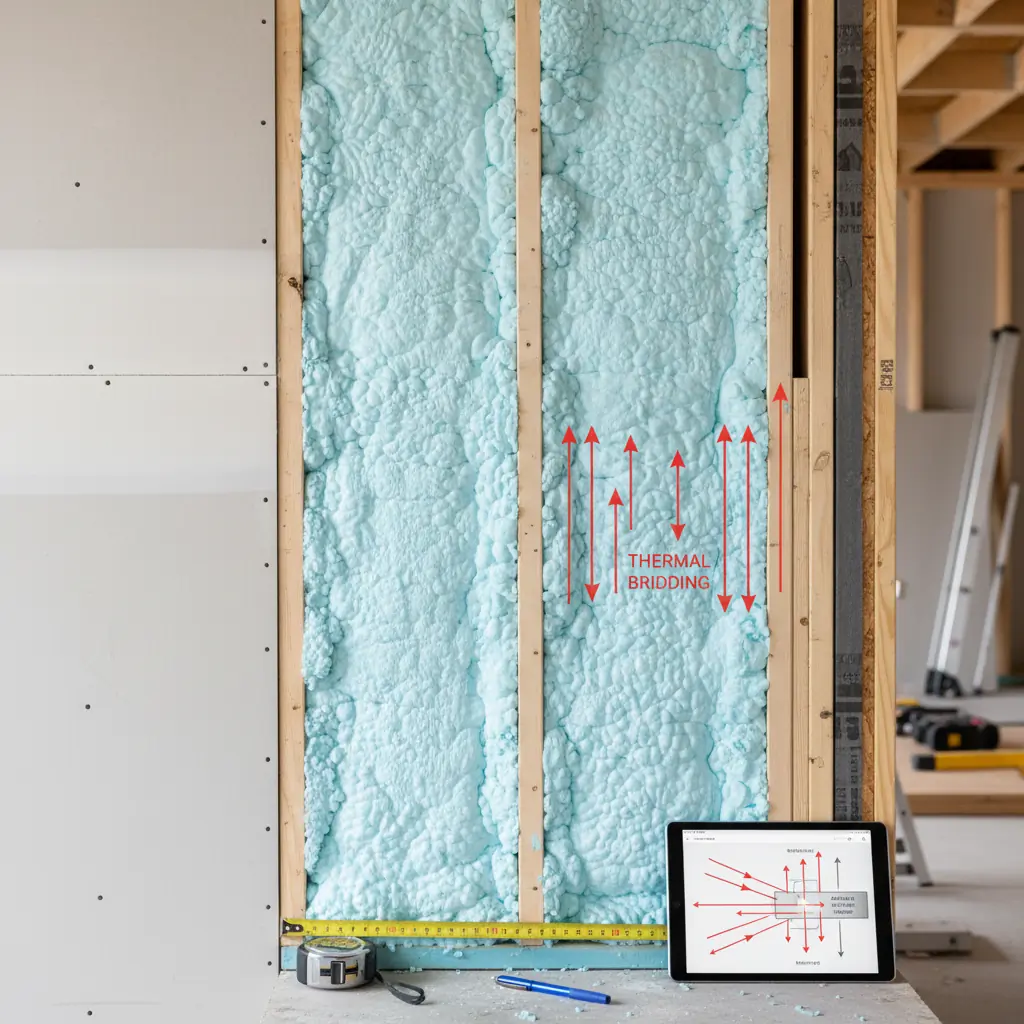
When a house is built, the R-value measures thermal resistance. A higher R-value means better insulation. Still, wall insulation performance exceeds the stated value. Framing members (studs) create thermal bridges that lessen effectiveness. I explain how to calculate the whole-wall R-value for a 2×6 wall with spray foam, show the math, and offer a simple calculator.
R‑Value Calculator
2x6 Wall with Spray Foam
What Is R‑Value and Why Does It Matter?
R‑value measures a material’s resistance to heat flow. It is expressed as hr·ft²·°F/Btu. The higher the R-value, the better the insulation. Building codes specify minimum R‑values for walls based on climate zones. For a 2×6 wall, typical cavity insulation R‑values range from R‑19 to R‑21 for fiberglass batts, but spray foam can achieve much higher values.
However, the R-value of just the insulation doesn’t tell the full story. Heat can travel through the wood studs, which have a much lower R-value than the insulation. This is called thermal bridging. To truly judge a wall’s performance, you need to find an area-weighted average that includes both the insulated parts and the studs.
Spray Foam Insulation Basics
- Open-cell spray foam: The foam cells are not fully closed, so the foam is softer and less dense. It has an R-value of about 3.5 per inch. It works well for blocking air, but it doesn’t stop water vapor.
- Closed-cell spray foam: The foam cells are fully closed and tightly packed, giving an R-value of 6.0 to 7.0 per inch. It also makes the wall stronger and helps block water vapor.
- Open‑cell: 5.5 × 3.5 = R‑19.25.
- Closed‑cell: 5.5 × 6.5 = R‑35.75 (using an average of 6.5).
But remember—this is only for the cavity. The studs will reduce overall performance.
Anatomy of a 2×6 Wall
A typical wood-framed wall has several layers.
Exterior air film (still air) – about R‑0.17.
Exterior cladding (siding, brick, etc.) varies. It is often omitted for simplicity, but we do include sheathing.
- Exterior sheathing (plywood or OSB) – about R‑0.62 for ½” (R‑1.25 per inch).
- 2×6 studs are spaced 16 or 24 inches apart. Each stud is really 1.5 inches wide and 5.5 inches deep. Wood’s R-value is about 1.25 per inch, so a 5.5-inch stud has R-6.875.
- Cavity insulation – spray foam fills the entire cavity.
- Interior drywall – ½” drywall has about R‑0.45.
- Interior air film – about R‑0.68.
The studs and the spaces between them occupy different areas of the wall. To estimate the framing percentage, divide stud width (1.5 inches) by stud spacing (16 or 24 inches on center). For 16 inches on center: 1.5 / 16 = 9.375%. For 24 inches: 1.5 / 24 = 6.25%. This basic method only counts standard vertical studs. Real construction includes extra framing at corners, intersections, and openings (such as king, jack, and end studs). These may raise the framing fraction to 12–15% for a typical wall. For accuracy, use your plans to count all framing and divide by wall area. If you do not have plans, use the basic percentage as an estimate, but actual framing is often higher. The rest of the wall is usually an insulated cavity.
The Formula for Whole‑Wall R‑Value
To combine the thermal performance of different sections, we use the U‑value (thermal transmittance), which is the reciprocal of the R‑value: U = 1/R. U‑values can be area‑weighted and then converted back to R-values.
- U_stud = 1 / R_stud (the total R‑value of the stud section, including all layers).
- U_cavity = 1 / R_cavity (the total R‑value of the cavity section, including all layers).
- A_stud = area of studs (as a fraction or in square feet).
- A_cavity = area of cavities.
- A_total = total wall area (A_stud + A_cavity).
Then the effective whole‑wall R‑value is.
R_effective = 1 / U_total.
Important: R‑values of different layers are additive. So for each path (stud or cavity), you add the R‑values of all layers (exterior air film, sheathing, stud/cavity insulation, drywall, interior air film) to get the total R for that path.
Step‑by‑Step Example
- Stud spacing: 16″ on center.
- Spray foam: Closed‑cell, R‑6.5 per inch → cavity R = 5.5 × 6.5 = 35.75.
- Exterior sheathing: ½” OSB, R‑0.62.
- Interior drywall: ½”, R‑0.45.
- Air films: exterior 0.17, interior 0.68 (total 0.85).
- Stud: wood R‑1.25 per inch × 5.5″ = 6.875.
- Add sheathing: 0.62
- Add drywall: 0.45
- Add air films: 0.85.
- R_stud_total = 6.875 + 0.62 + 0.45 + 0.85 = 8.795
- Cavity insulation: 35.75
- Sheathing: 0.62
- Drywall: 0.45
- Air films: 0.85
- R_cavity_total = 35.75 + 0.62 + 0.45 + 0.85 = 37.67.
- For a stud spacing of 16 inches, the stud area fraction = 1.5/16 = 0.09375 (9.375%).
- Cavity fraction = 1 − 0.09375 = 0.90625 (90.625%)
- U_stud = 1 / 8.795 = 0.1137
- U_cavity = 1 / 37.67 = 0.02655
If you used open-cell foam (R-3.5 per inch, cavity R = 19.25), the overall R would be about 17.2 (try it!).
Why This Matters for Building Codes and Energy Efficiency?
Building energy codes (such as the International Energy Conservation Code – IECC) specify minimum insulation R-values for walls. However, many codes now require consideration of the whole-wall R-value, or prescribe a continuous insulation layer to minimize thermal bridging. For a 2×6 wall with spray foam, the whole-wall R-value may still meet or exceed code, depending on your climate zone.
For example, the IECC 2021 requires R-20 for Zone 4 wood-frame walls. Our closed-cell example (R-28.8) exceeds that. In colder zones (Zone 6 requiring R-20+5 or R-25+10), you might need additional exterior insulation.
Factors That Affect Real‑World R‑Value
- Installation quality: Gaps, empty spots, or poor filling can lower performance. If installed well, spray foam completely fills the space and blocks air.
- Temperature: R‑values are tested at a 75°F mean temperature. At acutely chilly temperatures, some insulations (especially foam) may have slightly lower R‑values.
- Moisture: Waterlogged insulation loses R‑value. Proper vapor control is essential.
- Aging: Some foam insulation may lose R-value over time due to gas diffusion, but high-quality closed-cell foam holds up well.
- Air leakage: Air movement bypasses the insulating material. Spray foam’s air‑sealing ability is a major perk, contributing to overall energy efficiency beyond just R‑value.
Using the R‑Value Calculator
- Wall height and length (optional, to compute area, area fractions are drawn from stud spacing, so you can just use percentages).
- Stud spacing (16″ or 24″ o. c.).
- Spray foam type (open‑cell or closed‑cell) or custom R‑value per column inch.
- Additional layers: sheathing, drywall, and air films are included with default values that you can adjust.
- Exterior continuous insulation, if applicable.
- Cavity R‑value.
- Whole‑wall effective R‑value.
- Percentage reduction because of thermal bridging.
- Comparison to typical code requirements (optional).
Frequently Asked Questions
- Q: Why does the stud decrease the R-value so much?
A: Wood has a much lower R-value per inch than foam. Heat flows more easily through the studs, creating a thermal bridge. Even though studs occupy about 9% of the wall area, they can reduce the overall R-value by 20-30%.
- Q: Can I eliminate thermal bridging?
A: Yes, by adding exterior continuous insulation (rigid foam) over the sheathing. This covers the studs and dramatically improves the whole-wall R-value. Many energy codes now require this in many climates.
- Q: Should I use open-cell or closed-cell spray foam?
A: Closed-cell gives a higher R-value per inch and adds structural strength; it costs more. Open-cell is cheaper and still provides excellent air sealing, but requires thicker walls to achieve the same R-value. Choose based on your budget, climate, and needs.
- Q: Does the estimator account for windows and doors?
A: No, it assumes a solid surround area. For whole‑house calculations, you must account for openings separately.
- Q: What about the R‑value of air films?
A: Air films are thin layers of still air on interior and exterior surfaces. They supply a little R‑value and are included in standard assembly calculations. Our defaults (0.68 interior, 0.17 exterior) are typical for vertical surfaces.
- Q: How precise is this calculator?
A: It uses common engineering formulas and typical material R‑values. For precise results, use R‑values from your specific product data sheets.
Conclusion
To accurately assess the thermal performance of a 2×6 wall with spray foam, you need to account for thermal bridging through the studs. By using the area-weighted U-value method, you can determine the true whole-wall R-value and make informed decisions about insulation options and code compliance. Our calculator simplifies this process – just enter your wall details and get instant results.
Remember, a well‑insulated fence is more than just the insulation; it’s the entire assembly running together. Spray foam offers excellent R‑value and air-waterproofing, but understanding the consequences of the framework helps you design a truly energy‑efficient house.