
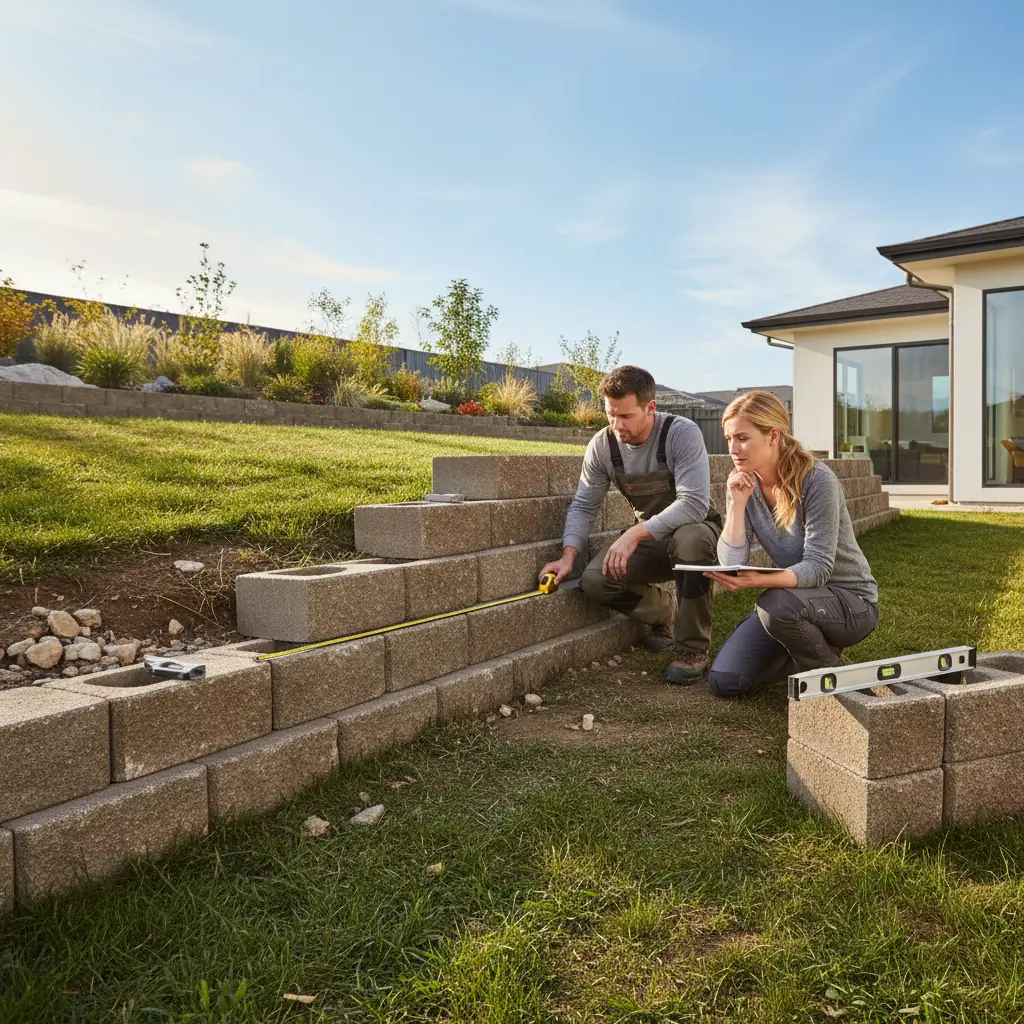
Building a retaining wall on a sloping property is a smart way to prevent erosion, create usable terraces, and add landscape appeal. But before you rent a truck and head to the home centre, you need to know exactly how many blocks to buy. Order too few and your project stalls; order too many and you waste money. This guide explains the geometry behind retaining wall calculations and how our Retaining Wall Block Calculator for Sloped Yards takes the guesswork out of the equation.
Why a Sloped Yard Changes the Math
A retaining wall on level ground has a constant height – its face is a simple rectangle. But when the ground slopes, the wall’s height gradually changes from one end to the other. The wall face becomes a trapezoid (or a triangle if the slope starts at ground level). To accurately estimate materials, you need the area of that trapezoid, not just length times an average height.
Our calculator handles this automatically, but understanding the process helps you measure correctly and interpret the results.
Step 1: Measure Your Wall
Grab a tape measure, a notepad, and a friend (or a long builder’s level). You’ll need three numbers:
- Wall length (L) – the horizontal distance from one end of the wall to the other, measured along the ground line.
- Low‑end height (H₁) – the vertical height of the wall at its lowest point.
- High‑end height (H₂) – the vertical height at the highest point.
All measurements should be in the same unit (feet recommended). If your wall will have a buried base course (common for stability), measure only the exposed face height. The calculator works with finished exposed heights.
Step 2: The Trapezoid Area Formula
The face of a sloping wall is a trapezoid. Its area is:Area=L×2H1+H2
This formula averages the two heights and multiplies by the length. It’s the same formula used by engineers and landscape architects.
Example:
If your wall is 20 ft long, 2 ft high at one end and 4 ft high at the other:Area=20×22+4=20×3=60 square feet.
If the ground were level (both ends same height), the formula still works – it simply gives the area of a rectangle.
Step 3: Know Your Block’s Coverage
Retaining wall blocks come in many sizes, but two dimensions matter for coverage: face height and face length. These are usually given in inches, while your wall area is in square feet – so you must convert.
Block face area (square feet) =144Height (in)×Length (in)
For example, a common 8″ × 16″ block covers:1448×16=144128≈0.89 sq ft per block.
Always check the manufacturer’s specifications. Some blocks have a slightly different nominal size, and specialty blocks (like cap blocks) may have different coverage.
Step 4: Exact Number of Blocks (Before Waste)
Divide the total wall area by the coverage per block:Exact blocks=Block areaWall area
Continuing our example:60÷0.89≈67.4 blocks.
This number is almost never an integer – you can’t buy 0.4 of a block, so the next steps adjust for real‑world needs.
Step 5: Why You Need Extra Blocks (Waste)
Every masonry project requires a waste allowance. Reasons include:
- Cutting – blocks at ends, corners, and around curves must be cut.
- Breakage – a few blocks may crack during transport or installation.
- Pattern adjustments – if you’re using a running bond, half‑blocks are needed at staggered joints.
- Future repairs – keeping a few spare blocks ensures you can match the wall years later.
A typical waste factor is 5% to 10%. For a simple straight wall, 5% often suffices; for walls with curves or corners, use 10%. Our calculator lets you enter your own percentage.Blocks with waste=Exact blocks×(1+100Waste %)
In our example with 5% waste:67.4×1.05=70.77 blocks.
Step 6: Round Up to Whole Blocks
Since you can only purchase whole blocks, round up to the nearest integer:Blocks to buy=⌈70.77⌉=71 blocks.
Always round up, never down. It’s better to have a few leftovers than to run short mid‑project.
Putting It All Together: A Complete Example
Let’s run a full scenario through the calculator:
- Wall length = 24 ft
- Low end height = 1.5 ft
- High end height = 3.5 ft
- Block size = 7″ high × 18″ long
- Waste = 7%
1. Wall area24×21.5+3.5=24×2.5=60 sq ft
2. Block area1447×18=144126=0.875 sq ft/block
3. Exact blocks60÷0.875=68.57 blocks
4. With waste68.57×1.07=73.37 blocks
5. Round up → 74 blocks to purchase.
Factors That Can Affect Your Block Count
While the calculator gives a solid estimate, consider these additional factors:
- Base course below grade – If your design requires the first course to be partially buried, the exposed height is what matters. Measure from finished grade to the top of the wall, not including the buried portion.
- Curved walls – For gentle curves, the trapezoid formula still works if you measure the length along the curve. For sharp curves, you may need to calculate in sections.
- Corner blocks – Inside or outside corners may require special blocks or additional cuts; factor this into your waste percentage.
- Block type – Interlocking blocks may have a slightly different effective face area due to flanges; always use the manufacturer’s stated coverage.
Pro Tips for Accurate Measurement
- Stake and string line – Set stakes at both ends and run a level string line to establish the top of the wall. Measure the vertical drop at regular intervals to confirm the slope is consistent.
- Use a laser level – For long walls, a laser level gives precise height readings.
- Double‑check block dimensions – Some blocks are sold by “nominal” size; actual dimensions may be a fraction smaller. Measure a sample block yourself.
- Order a little extra – Even after rounding up, it’s wise to add one or two blocks for peace of mind.
Frequently Asked Questions
Q: Can I use this calculator for segmental retaining wall blocks?
A: Yes, as long as you know the face dimensions. The calculator works for any rectangular block.
Q: What if my wall is not a straight line?
A: For curved walls, measure the curved length along the wall face. The trapezoid area formula still applies if the height changes linearly along that curve. For complex shapes, divide the wall into sections and calculate each separately.
Q: Do I need to subtract openings like drainage pipes?
A: Most residential walls don’t have openings large enough to affect the total block count significantly. If you have a large opening (e.g., a staircase), you can subtract its area manually.
Q: How do I handle cap blocks?
A: Cap blocks are usually calculated separately because they are a different size. Measure the wall length and divide by the cap block length (including any overhang). Add waste separately.
Why This Method Works (The Math Behind It)
The trapezoid area formula is derived from the average width times the height. In calculus terms, it’s the integral of a linear function. For a slope that isn’t perfectly linear (e.g., a curved slope), you would need more advanced methods, but for most residential yards a linear slope assumption is sufficiently accurate.
The block coverage conversion from inches to square feet uses the fact that 1 square foot = 144 square inches – a fixed conversion.
Waste percentage is an empirical factor; industry standards for masonry range from 5% to 10%. Rounding up ensures you have whole blocks without cutting a block into fractions on site.
Ready to Build Your Wall?
Now that you understand the calculations, you can use our Retaining Wall Block Calculator with confidence. Simply enter your wall length, both end heights, block dimensions, and your preferred waste percentage – the calculator does the rest instantly. It’s designed for both DIYers and professionals, and it’s fully mobile‑responsive so you can use it on site.
[Insert the calculator code here or link to it]
Remember: Good planning saves time, money, and frustration. Measure carefully, account for waste, and always buy a few extra blocks. A well‑built retaining wall will enhance your property for decades.