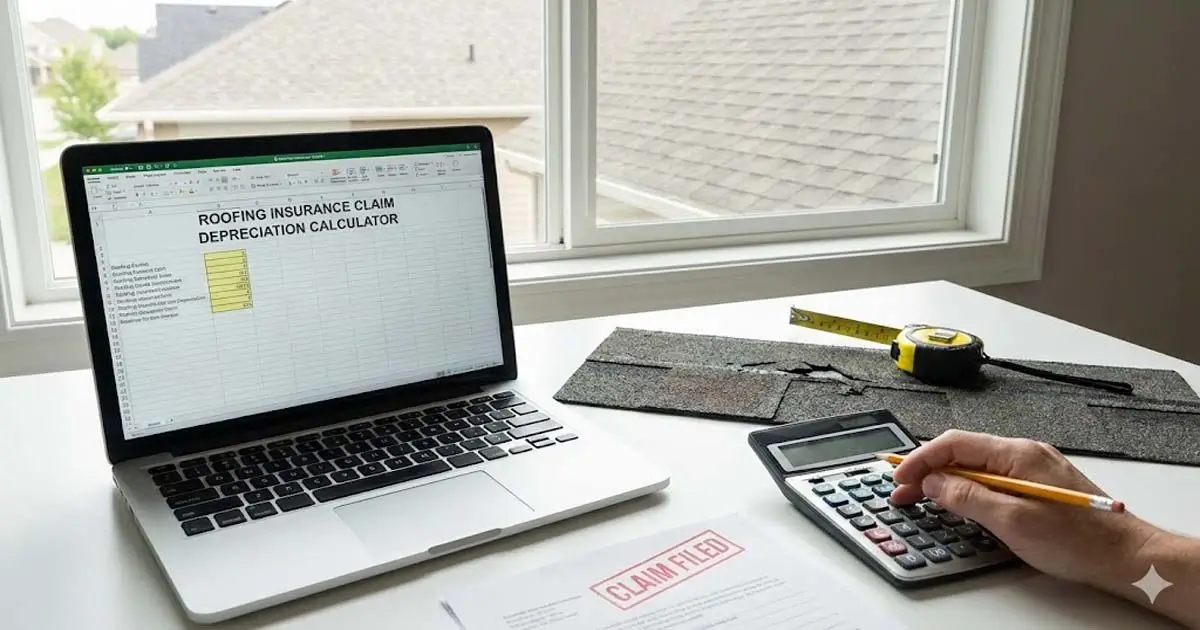
Filing a roof insurance claim can be confusing, especially with terms like depreciation, Actual Cash Value (ACV), and Replacement Cost Value (RCV). Many homeowners expect to pay the full cost of a new roof but find that the first payment is less than they thought.
Insurance companies use depreciation to lower your first payment based on your roof’s age and condition. Understanding this can help you estimate your claim and maximize your policy benefits.
To help you better understand your claim, this guide explains how roof insurance claims work, how depreciation is calculated, what factors affect your payout, and how you can use a calculator to estimate your settlement.
✨ Based on straight‑line depreciation. Check your policy for non‑recoverable clauses. ✨
How Roof Insurance Claims Work.
If your roof is damaged by a covered event such as hail, wind, fire, or falling debris, you can file an insurance claim. The insurance company will send an adjuster or have a review contractor estimate the current cost to replace your roof. This amount is known as the Replacement Cost Value (RCV), which reflects the cost to install a new roof of similar quality and materials at today’s prices.
Since roofs wear out, insurers don’t pay the full replacement cost upfront. They deduct depreciation—the value lost from age and use—and pay the Actual Cash Value (ACV) as your first payment. After you complete repairs and show proof, they pay the remaining amount, called recoverable depreciation. So, you get the full amount of your policy minus your deductible.
Understanding Replacement Cost Value (RCV)
Replacement Cost Value is the cost to replace your roof today, without factoring in its age or condition. ions generally include:
Materials and labor costs
Contractor overhead and profit
Removal and disposal of old roofing
Permits and related construction fees are also included.
Insurance companies figure out replacement costs using software, contractor bids, and local pricing data. Since construction prices change, RCV is based on today’s rates, not what your roof originally cost. RCV matters because it sets the highest amount your insurance might pay under most current homeowners policies. Value is the depreciated value of your roof at the time of loss. Simply put, ACV equals the replacement cost minus depreciation.
Insurers use ACV because an older roof has already given you some of its value. Paying the full replacement cost right away would mean you get a brand new roof after years of use, which isn’t fair to the insurer. Payment is considered a fair estimate of the roof’s remaining value before the damage occurred. is the gradual loss of value caused by aging, weather exposure, and normal wear and tear. Every roofing material has an expected lifespan, and insurers assume the roof loses value evenly over that period.
Most insurance companies apply straight-line depreciation. Most insurers use straight-line depreciation, which means the roof loses the same amount of value each year over its expected life. A roof that lasts 25 years loses about one-twentieth of its value each year. As the roof ages, depreciation increases proportionally. cted Lifespan of Common Roofing Materials
Different roofing materials wear out at different speeds, which changes how depreciation is calculated.
Asphalt shingle roofs last 20–30 years, wood shake roofs 20–25 years, metal roofs 40–70 years, and tile or slate roofs 50–100 years if well maintained.
Since different materials last longer than others, two roofs of the same age can have different depreciation amounts.
Insurance depreciation uses a simple formula that homeowners can figure out on their own.
Annual Depreciation Rate
Annual Depreciation Rate = 100% ÷ Expected Lifespan (years). This tells you how much value your roof loses each year. year.
Total Depreciation
Total Depreciation = Annual Depreciation Rate × Roof Age × Replacement Cost Value
Actual Cash Value
ACV = Replacement Cost Value − Total Depreciation
These formulas let homeowners estimate their claim payments before the insurance company gives them the official numbers. would cost $10,000 to replace it today, and the roof’s expected lifespan is 25 years.
The annual depreciation rate would be 4%. After 15 years, your roof has lost 60% of its value.
So, the depreciation comes to $6,000. If you subtract that from the replacement cost, the actual cash value (ACV) is $4,000. If your deductible is $1,000, your first insurance payment would be $3,000. After you finish the roof replacement and send in your receipts, the insurer pays the recoverable depreciation of $6,000. Altogether, you get $9,000, which is the replacement cost minus your deductible.
Recoverable vs Non-Recoverable Depreciation:
Insurance policies calculate depreciation differently. Recoverable depreciation allows you to claim back the depreciated amount after repairs or replacements are completed, while non-recoverable depreciation means you cannot recover that value. Whether depreciation is recoverable or not can make a big difference in your final payout.
Recoverable Depreciation
Recoverable depreciation means the insurer holds back part of the payment at first, then pays it after you finish the repairs. This is common with replacement-cost policies and helps homeowners who quickly repair their property.
Non-Recoverable Depreciation
Non-recoverable depreciation means the amount held back is never paid. The insurer only pays the ACV, whether you repair the roof or not. This often happens with older roofs or less expensive insurance policies.
Homeowners should review their policy documents or speak with their insurance agent to determine the type of coverage they have.
Factors That Affect Roof Depreciation
Even though insurers use standard formulas, several things can affect depreciation. The roof’s condition before damage matters a lot. Poor maintenance, visible wear, or past repairs might make insurers give your roof a shorter lifespan. High-quality materials, such as premium shingles or metal roofs, usually depreciate more slowly. Climate can also affect inspections, especially in areas with severe storms or extreme temperatures. Policy add-ons may also affect depreciation, especially for older roofs nearing the end of their lifespan.
Because these factors can vary widely, even two similar roofs might receive different depreciation assessments. To make this process easier, a roof insurance calculator lets homeowners quickly estimate their claim payouts. Rather than doing the math yourself, yousimplyt enter a few numbers to see what your payment might be.
Start by entering the replacement cost value from an adjuster’s or contractor’s estimate. Next, enter your roof’s age in years and select the expected lifespan of your roofing material. Enter your insurance deductible and say if depreciation is recoverable. The calculator will then show the annual depreciation rate, total depreciation, ACV payment, and the final payout you can expect after repairs. It can also estimate and plan for repair costs more accurately.
Deductibles and Their Role in Claim Payments
A deductible is the portion you pay yourself. Unlike depreciation, it’s usually paid once and not reimbursed.
In most claims, the deductible is subtracted from the total payout. For most claims, the deductible is deducted from the total payout, not from each payment. Your final payment is the replacement cost value minus the deductible.nd RCV helps homeowners avoid confusion when comparing the first and final payments.
Many hMany homeowners mistakenly believe the first payment covers the full settlement, not realizing it is only a partial payment. Others delay repairs and miss out on recoverable depreciation because of policy deadlines. Failing to document roof age or maintenance history can result in higher depreciation estimates. Keeping installation records, inspection reports, and repair receipts can strengthen a claim and potentially increase payouts. Communication with contractors and adjusters is essential throughout the process.
Frequently Asked Questions About Roof Insurance Depreciation
Homeowners often ask what happens if their roof is older than its expected lifespan. In many cases, insurers only pay actual cash value (ACV) or set limits on reimbursement. A common question is how to negotiate depreciation, which refers to the reduction in value over time. Homeowners can challenge an adjuster’s estimate by providing proof of installation dates or maintenance records, which may support a higher claim amount.
People also ask about building code upgrades. If local rules require extra work when replacing your roof, some policies include Ordinance or Law coverage to pay for those costs separately from depreciation.
Why Using a Roof Insurance Calculator Matters
Insurance calculations can be confusing, and small mistakes may lead to unrealistic expectations. A depreciation calculator clarifies things by translating policy terms into real numbers. By estimating payouts in advance, homeowners can plan for repairs, compare contractor bids, and verify that the insurer’s numbers are correct. The calculator also shows how deductibles and depreciation work together, so you’re not surprised by extra costs.
Conclusion
Roof insurance depreciation can be confusing. Insurers base payments on replacement cost, but depreciation reduces the initial payout to reflect your roof’s age and prior use.
Knowing the difference between ACV and RCV, how depreciation is calculated, and whether it’s recoverable helps you handle claims with confidence. With accurate information and complete records, you can ensure you receive all the compensation your policy allows.
Use the roof depreciation calculator below to estimate your claim payout, determine your out-of-pocket costs, and plan your roof replacement with greater confidence.
This guide is provided for informational purposes only and does not replace professional insurance or legal advice. Always review your insurance policy and consult a licensed adjuster or contractor regarding your specific claim.