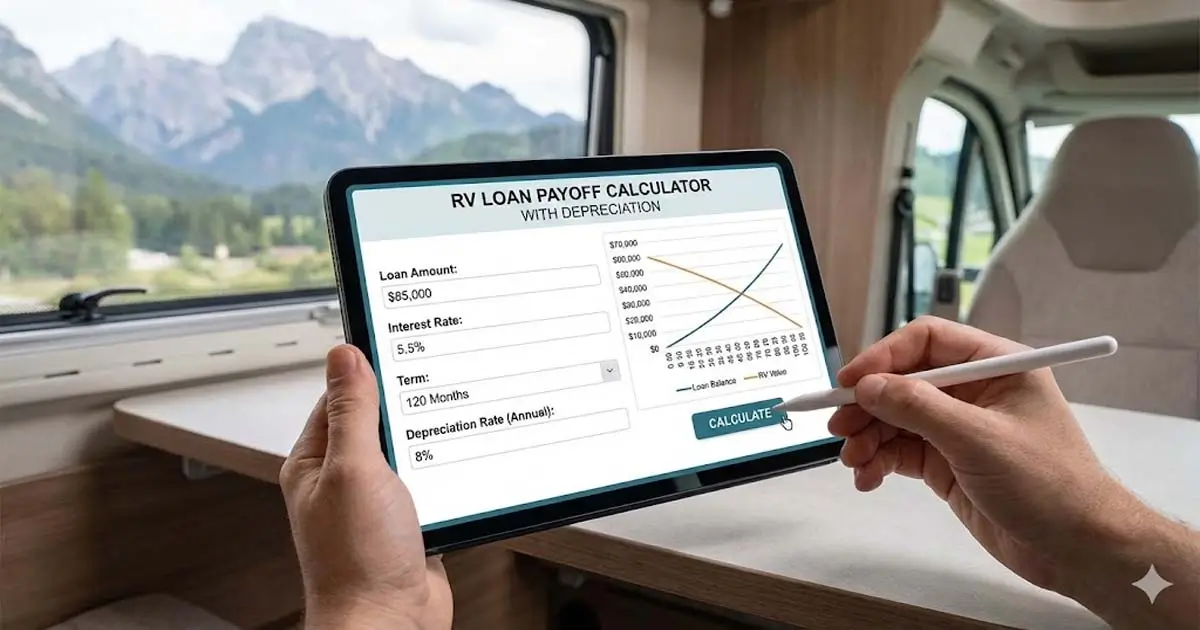
RVs let you travel comfortably, but differ from other investments. Most gain value over time; RVs lose value quickly, and loans are paid off slowly. This can lead to negative equity, often without owners realizing it.
If you understand how RV loans and depreciation work, you can plan your payments, keep track of what you owe, and know your RV’s current value. This guide uses formulas, examples, and real-life situations to illustrate how loans and depreciation interact.
RV Loan Payoff + Depreciation Estimate Equity Over Time
Typical 20% first year, then 15%
📅 Month:12
📆 Monthly Payment
—
💰 Loan Balance
—
🚐 RV Value
—
📈 Equity (Value – Balance)
—
✨ Depreciation is exponential; equity may be negative early on. ✨
Understanding the Financial Structure of an RV Purchase
An RV purchase involves two simultaneous financial processes:
Loan amortization gradually reduces your debt through monthly payments. Depreciation is the yearly drop in your RV’s value. It’s important to see how these work together.
If you pay off your loan more slowly than your RV loses value, you’ll end up with negative equity. But if you pay off the loan faster than the RV depreciates, you can build equity.
With these concepts in mind, let’s lay out the main terms before moving on to calculations.
Monthly Interest Rate = r=i/12r = i/12r=i/12
Loan Term (months) = nnn
Monthly Payment = PPP
Depreciation Rate = ddd
RV Value after time ttt = VtV_tVt
Remaining Loan Balance after kkk months = BkB_kBk
Step 1 — Loan Amount
PV = PP − DP
Here, PV is the amount you borrow, PP is the RV’s purchase price, and DP is the down payment you make. Subtract the down payment from the purchase price to find your loan amount.
Interest=113,932.80−75,000=38,932.80Interest = 113,932.80 – 75,000 = 38,932.80Interest=113,932.80−75,000=38,932You end up paying almost $39,000 just in interest. This shows why longer RV loans can make owning one much more expensive.st.
Remaining Loan Balance Calculation
After several payments, your loan balance does not decrease by the full payment amount because a portion of each payment is applied to interest.
After three years, you would still owe about $67,150.
RV Depreciation
Unlike loan payments, depreciation reduces your RV’s value quickly, especially in the first few years.Vt=PP×(1−d)tV_t = PP \times (1-d)^tVt=PP×(1−d)t
Where:
ddd = annual depreciation rate
ttt = years owned
For these calculations, assume your RV loses 20% of its value annually in the early years.
Let’s use these depreciation concepts in a practical example:
So, you lose $18,000 in value in just the first year.
Year 3
V3=90,00V3 = 90,000 × 0.512 = 46,080
After three years, your RV is worth less than half its purchase price.
Equity formula:
Equity=Vt−BkEquity = V_t – B_kEquity=Vt−Bk
Example After 3 Years
RV Value = $46,080 Loan Balance = $67,150
Equity = 46,080 – 67,150 = -21,070
If you sell the RV, you must pay the $21,070 difference yourself.
To better visualize this, it helps to look at your RV’s value and loan payoff month by month. In the early years, your RV loses value faster than you pay down the loan.
You may be wondering when your equity will turn positive.
Positive equity occurs when:
Vt>BkV_t >V_t > B_k. With long RV loans, you usually don’t reach positive equity until about 8 to 10 years in, depending on how quickly your RV loses value and how much you pay each month. If you make a bigger down payment or choose a shorter loan, you’ll reach positive equity sooner. Effect of Down Payment (Numerical Comparison)
In short, making a larger down payment can greatly reduce your financial risk. Longer loan terms make monthly payments smaller, but you’ll stay in negative equity for a longer time. The RV Loan & Dep calculator works out several equations at once for you.
44,600−92,000=−47,40044,600 – 92,000 = -47,4004Even after five years of payments, you could still have a big negative equity gap.ive years of payments.
Financial Strat The math poi15 Financial Strategy.
The calculations suggest several practical ways to lower your financial risk, such as choosing shorter loan terms.
Make extra principal payments. Even adding $100 per month to your principal helps you pay off your loan faster. Many buyers focus on the monthly payment, but the real cost of owning an RV depends on three factors: interest, balance, and depreciation.
Interest accrued. Keeping track of all three gives you a clear picture of your finances. A calculator turns these formulas into useful information, so you can decide when to refinance, sell, or upgrade your RV.
Owning an RV can be a great experience, but it takes careful financial planning. Since RVs depreciate quickly and loans are paid off slowly, it’s important to understand how value and debt interact. By using loan formulas, depreciation models, and equity calculations, you can see where you stand financially at any point.
An RV loan and depreciation calculator makes these numbers easy to understand, so you can quickly see your payments, balance, and how much value you’ve lost.antly.
Try the calculator below to test different scenarios, compare loan options, and make smart financial decisions before and after you buy your RV.
This guide is for educational purposes only and should not replace professional financial advice.