
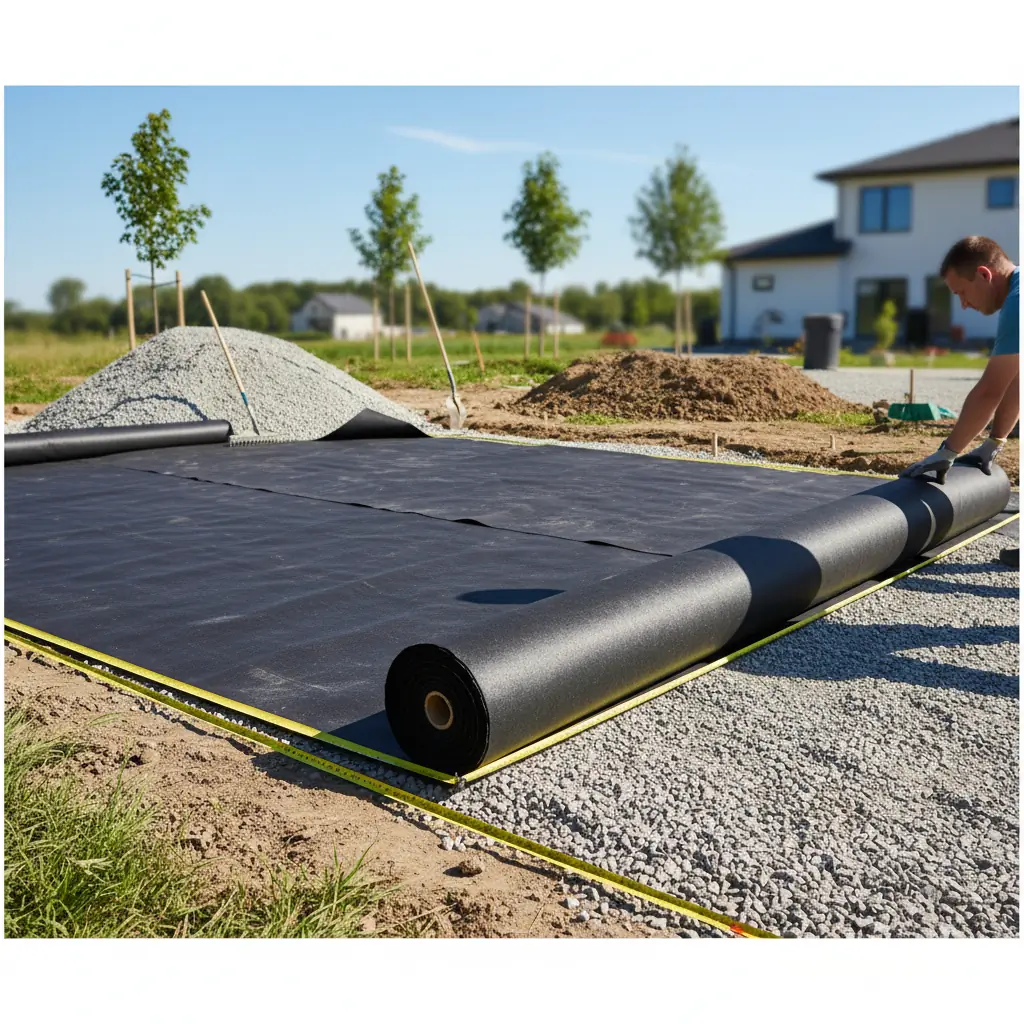
The Ultimate Guide to Geotextile Fabric for Driveways

5/5 - (1 vote)
12.5 ft = 150 in
📦 Number of Strips
📏 Linear Feet
📐 Area (sq ft)
📐 Area (sq yd)
📦 Rolls Needed
Results based on standard overlaps. Add extra for curves or waste.
Building a gravel driveway that lasts for years needs more than hard work. It also requires good planning and careful measurement. Many people figure out how much material they need by looking at the driveway’s size, but this can leave you short or overspend. Unlike figuring out a floor’s area, you must use a different approach, called “strip by strip counting”, when working out how much driveway fabric to use.
Geotextile fabric is sold in long rolls with fixed widths, often 12.5 feet or 15 feet. Since most driveways are wider than a single roll, you need to install several strips side by side. These strips must overlap each other significantly, which is necessary to maintain the driveway’s strength and prevent fabric movement and soil mixing. The overlap means that part of each strip’s width is not available for covering new ground. If you only multiply the driveway’s length by its width when ordering fabric, you will overlook the section used for overlaps and almost certainly end up short.

With this in mind, let’s move into the core calculations by first defining the main variables you’ll need.

To calculate the right amount of material, start by identifying the key measurements that affect how much fabric you need.
  • Ldrive (Driveway Length):: The total distance of the driveway in linear feet.
  • Wdrive (Driveway Width): The measurement across the driveway.
  • Wfabric (Fabric Width): The fixed width of the roll (usually in inches, e. g., 150 or 180 inches).
  • Olap (Required Overlap): The width of the fabric that must be layered over the adjacent strip (usually 12 to 24 inches).

The Concept of E. The most important idea in geotextile calculation is “Effective Width.” When you lay out a roll of fabric, you don’t get the full width for covering your driveway because some of it is used up in the overlap.

We calculate effective coverage using this formula.
Total Linear Ft = Strips × Ldrive
.
Note: We divide by 12 to convert the fabric’s inches of overlap into feet, matching the unit used for the Example: If you use a standard 12.5-foot roll (150 inches) and need a 12-inch overlap, you actually get 11.5 feet of usable width, not the full 12.5 feet.Getting 11.5 feet.
Sq Yards = Total Linear Ft × (Wfabric / 12)
9
.
This 11.5-foot efThis 11.5-foot effective width is what you must use to determine how many strips are needed to span the driveway. To find out, divide the total driveway width by the effective width, and always round up, since you can’t install a half-strip. For example, if the driveway is 24 feet wide and your effective width is 11.5 feet, divide 24 by 11.5 to get about 2.08. Even though you only need a bit more than 2 strips, you’ll have to round up and purchase 3 full strips to fully cover the driveway due to the necessary overlaps.
Strips = 24 = 2.08
11.5
Result: You need to round 2.08 up to 3 strips.near Footage and Square Yardage Conversions.
Multiply the number of strips by the driveway length to get the total linear feet.trips × 100 feet = 300 feet. To convert to square yards for ordering: Multiply total feet by roll width, then divide by. Let’s explore each engineering function, starting with Separation and a major challenge:
Mud pumping.
The primary  cause of driveway failure is not the crushing of the stone; however, it is the movement of the stone. The main reason driveways fail is not that the stone gets crushed, but that it moves out of place. Without a barrier, large gravel and fine soil will mix together under pressure, creating a high-pressure zone that pushes the stone down. Simultaneously, the wet soil (fines) beneath acts like a fluid, pumping upward into the voids between the stones. Over time, your sanitary layer of gravel becomes a mixture of mud and stone. This mixture loses its ability to drain water and support weight, leading to. to.
  • Rutting: Deep tracks forming in whatever place tires travel.
  • Potholes: Localized structural failures that hold water.
  • Aggregate Loss: The expensive gravel effectively disappears into the earth.
Driveway fabric works like a filter:
It lets water pass through but blocks soil from moving upward. Its small holes are big enough for water but too small for dirt. This keeps your gravel clean and strong. The fabric’s strength also helps distribute the weight of cars across the ground.
When a tire sits on a gravel driveway, its weight is concentrated on a small spot. If the ground beneath is soft, this pressure can be too much, causing the soil to slip and the wheel to sink. Textile fabric introduces tension into the system. As the wheel pushes down, the fabric tightens, dispersing that downward force across a much wider surface. By spreading the load, the burden per square inch on the subgrade is significantly reduced, thereby increasing the ground’s bearing capacity. This allows you to build an unchanging driveway over soil that would otherwise be exorbitantly soft to support a vehicle.

Choosing the right type of fabric is very important.

There are two main types: woven and non-woven. They may look similar, but they work differently and have different strengths.

One of the most common errors in building driveways is choosing the wrong type of fabric. Woven and non-woven geotextiles may look alike, but they have very different strengths and uses. way Standard.
Woven driveway fabrics are made by weaving plastic threads together, like a sack. This makes them very strong and hard to stretch. Woven fabric still lets water through, but not as quickly as non-woven types. It helps hold the road in place and allows water to drain out slowly.
  • Best Use Case: Driveways, access roads, parking lots, and construction entrances.
  • Key Specs: Look for “Grab Tensile Strength” of 200 lbs, 315 lbs, or higher (ASTM D4632).
For 90% of driveways, for most driveway projects, woven stabilization fabric is the best choice. It provides the strong support needed to distribute the weight of vehicles.les: The Drainage Master.
Non-woven driveway fabrics feel like thick felt. They are made by bonding fibers together. Because the fibers are not woven, this fabric is more stretchy. Non-woven fabric lets water rush through very quickly.


Best Use Case:

French drains, septic fields, pipe wrapping, and if the fabric stretches under a car, it cannot support the weight, and the ground underneath takes all the pressure. Lighter versions are too stretchy. If the fabric stretches under a car, it cannot support the weight, and the ground underneath takes all the pressure. There is also a big difference between ‘driveway fabric’ and ‘weed barrier.’ The black plastic sheets sold at stores are only for stopping weeds in gardens. They are very weak and will break quickly if cars drive over them. Always make sure your fabric is rated for use under heavy loads.

Having reviewed how to select the right fabric, let’s move on to best practices for installation. Proper installation is just as important as choosing the right material.

Ranking the method for installing driveway fabric requires a detailed understanding of the physical workflow. The installation quality is just as crucial as the material calculation; a poorly installed fabric will pull apart and fail.

Subgrade Preparation

Before unrolling any fabric, the ground (subgrade) must be prepared.


Excavation:

Remove topsoil and organic matter (grass, roots, leaves). Organic matter decomposes over time, creating voids that will cause the driveway to settle unevenly. The excavation: Remove all topsoil and any organic material, such as grass, roots, and leaves. If left in place, these will break down and cause the driveway to settle unevenly.

For most homes, digging down 8 to 12 inches is standard, but the exact depth depends on how much traffic the driveway will get.ac

Grading: Shape the bottom of the trench to match the final slope or crown of the driveway. This helps water run off the ground below, not just the surface.c,

Compaction: Many DIYers skip this step, but it’s important. Use a plate compactor or trench roller to pack down the soil. If the soil is loose when you lay the fabric, it will settle later and cause the fabric to shift, creating points where the overall structure can move. The fabric should be taut like a drum skin.

Overlap Direction: When laying strips on a slope, always overlap in a “shingle” pattern. The uphill stripOverlap direction: On slopes, always overlap the strips like shingles. The strip higher up the slope should cover the one below it. This way, water flows over the joint rather than under it. Providing that the subgrade is pliable (you leave footprints when walking on it), increase the overlap to 24 inches. This extra friction prevents the sheets from sliding apart as gravel is spread.

Pinning and Securing the Fabric.

Wind and the physical action of spreading gravel can displace the fabric. Secure it before the stone arrives.
  • Fasteners: Use 6Fasteners: Use 6-inch steel sod staples or 60-penny nails. Wind and spreading gravel can move the fabric out of place. Secure it before you bring in the stone. Respectively,  every 3 to 5 feet to prevent theWhen going around curves, you may need to cut and fold the fabric (as when pleating a skirt).ating a skirt). Regularly cut the fabric and overlap the cut edges by Curve management: When working around curves, you may need to cut and fold the fabric, similar to pleating a skirt. Cut the fabric as needed and overlap the cut edges well to keep the barrier strong. Don’t bunch up the fabric, as this can trap water. can tear the material or pull the overlaps apart.
  • Back-Dumping: Have the dump truck back up to the edge of the fabric and dump the stone onto the fabric.
  • Spreading: Use a loader or rake to push the stone out of the area. Back-dumping: Have the dump truck back up to the edge of the fabric and dump the stone onto it. A minimum of 4 to 6 inches of compacted stone between the equipment tires and the fabric at all times. This cushion protects the geotextile from puncture and shear forces.

FAQs

Understanding CBR (California Bearing Ratio).

In professional civil engineering, the need for geotextiles is often determined by soil CBR. California Bearing Ratio is a penetration test that compares the strength of soil to that of a standard crushed rock.
  • CBR > 10 (Good): Difficult, rocky, or sandy soil. It drains well and supports weight. Fabric is used here primarily for separation (to prevent stone loss). Standard 12-inch overlap is adequate.
  • CBR 3 – 10 (Fair): Typical silty or loamy soils. Fabric provides both separation and stabilization.
  • CBR < 3 (Poor): Squishy clay, peat, or muck. Walking on it feels spongy. Here, the fabric is critical for survival. High-strength woven fabric (315 lbs+) and large overlaps (24-36 inches) are mandatory. In extreme cases (CBR < 1), geogrids may be required in addition to fabric.

Dealing with Curves and Irregular Shapes.

Driveways are rarely ideal rectangles. During the time that you. Driveways are rarely perfect rectangles. When figuring out material for curves, treat each curve as a series of straight lines or calculate the total area and add 15-20% extra for waste. until it goes off-path.ath.
  1. Cut the fabric.
  2. Start a new strip at a different angle, making sure the whole cut edge is covered by the previous strip. Because of that, you will perpetually order extra material if your driveway has significant winding.worth the cost?
  • Material Cost: Woven driveway fabric typically costs between $0.15 and $0.30 per square foot. For a typical 2,000 sq ft driveway, this is an investment of roughly $300-$600.
  • Gravel Cost: Gravel can cost $1,500 to $3,000 per area, depending on depth and local pricing.
  • Longevity: A driveway without fabric may need new gravel added every 2-3 years as the stone sinks. With fabric, your driveway can last 10-15 years with little maintenance.
  • ROI: The cost of the fabric usually pays for itself in the first 3 years by saving you from buying more gravel. Many people see it as cheap insurance for their driveway investment.

Conclusion

Using geotextile fabric turns a simple gravel path into a long-lasting driveway. By following the right math—especially the Effective Width calculation—you make sure you have enough material for the job. Applying these principles is what keeps your driveway strong and prevents it from sinking over time.

Leave a Comment